• Ladies, there’s a simple and clear path to a man’s heart, and it shows in how you show up for him.

    First, be intentional about meeting his needs this could be through care, support, or creating a peaceful space around him. It’s not just about cooking or chores, but the effort and thought behind what you do.

    Second, build trust. Respect his privacy, keep his matters between you, and stay away from gossip. A man values a woman he can feel safe with, someone who protects what he shares.

    Third, handle his heart with care. Everyone has weak moments don’t shame or belittle him for them. Offer understanding instead of judgment, and stand by him as he grows.

    When a man feels respected and valued in these ways, it naturally draws him closer. Genuine love often grows where there is consistency, loyalty, and emotional safety.
    Ladies, there’s a simple and clear path to a man’s heart, and it shows in how you show up for him. First, be intentional about meeting his needs this could be through care, support, or creating a peaceful space around him. It’s not just about cooking or chores, but the effort and thought behind what you do. Second, build trust. Respect his privacy, keep his matters between you, and stay away from gossip. A man values a woman he can feel safe with, someone who protects what he shares. Third, handle his heart with care. Everyone has weak moments don’t shame or belittle him for them. Offer understanding instead of judgment, and stand by him as he grows. When a man feels respected and valued in these ways, it naturally draws him closer. Genuine love often grows where there is consistency, loyalty, and emotional safety.
    0 Comments 0 Shares 647 Views
  • 1. Sell women Beauty

    2. Sell men Lust

    3. Sell parents Peace

    4. Sell kids Dreams

    5. Sell the rich Safety

    6. Sell the broke Hope

    7. Sell the old Youth

    8. Sell the young Status

    9. Sell the lonely Belonging

    10. Sell the sick Miracles

    11. Sell the healthy Fear

    12. Sell the smart Shortcuts

    13. Sell the dumb Validation

    14. Sell the faithful Certainty

    15. Sell the faithless Rebellion

    16. Sell everyone Time

    You can make so much money. Try either. You can’t go wrong.

    Choose where money is.
    1. Sell women Beauty 2. Sell men Lust 3. Sell parents Peace 4. Sell kids Dreams 5. Sell the rich Safety 6. Sell the broke Hope 7. Sell the old Youth 8. Sell the young Status 9. Sell the lonely Belonging 10. Sell the sick Miracles 11. Sell the healthy Fear 12. Sell the smart Shortcuts 13. Sell the dumb Validation 14. Sell the faithful Certainty 15. Sell the faithless Rebellion 16. Sell everyone Time You can make so much money. Try either. You can’t go wrong. Choose where money is.
    0 Comments 0 Shares 541 Views
  • 1. Sell women Beauty

    2. Sell men Lust

    3. Sell parents Peace

    4. Sell kids Dreams

    5. Sell the rich Safety

    6. Sell the broke Hope

    7. Sell the old Youth

    8. Sell the young Status

    9. Sell the lonely Belonging

    10. Sell the sick Miracles

    11. Sell the healthy Fear

    12. Sell the smart Shortcuts

    13. Sell the dumb Validation

    14. Sell the faithful Certainty

    15. Sell the faithless Rebellion

    16. Sell everyone Time

    You can make so much money. Try either. You can’t go wrong.

    Choose where money is.
    1. Sell women Beauty 2. Sell men Lust 3. Sell parents Peace 4. Sell kids Dreams 5. Sell the rich Safety 6. Sell the broke Hope 7. Sell the old Youth 8. Sell the young Status 9. Sell the lonely Belonging 10. Sell the sick Miracles 11. Sell the healthy Fear 12. Sell the smart Shortcuts 13. Sell the dumb Validation 14. Sell the faithful Certainty 15. Sell the faithless Rebellion 16. Sell everyone Time You can make so much money. Try either. You can’t go wrong. Choose where money is.
    0 Comments 0 Shares 489 Views
  • Automobile tires have undergone a remarkable transformation over the last century, evolving from simple rubber coverings into highly engineered components critical for safety, comfort, performance, and efficiency. This evolution reflects changes in vehicle design, road conditions, driving speeds, and advances in material science.

    In the early 1900s and 1920s, tires were narrow, tall, and often mounted on spoked wheels. These early tyres were made from natural rubber with cotton fabric plies and had smooth or lightly grooved surfaces. They were designed mainly to cope with rough, unpaved roads and low vehicle speeds. Durability was limited, punctures were common, and ride comfort was basic. Bias-ply construction dominated this era, where fabric layers were laid diagonally across each other, making tires stiff and prone to heat buildup.

    By the 1930s and 1940s, tire designs became slightly wider and stronger. Rubber compounds improved, and tread patterns became more defined to enhance grip on wet and muddy roads. During this period, vehicles grew heavier and faster, especially due to wartime engineering advances, pushing tire manufacturers to focus more on load capacity and reliability.

    The 1950s marked a major visual and technical shift with the introduction of whitewall tyres, symbolizing style and luxury. More importantly, tire construction continued to improve, offering better comfort and longer life. In the late 1940s and 1950s, radial tire technology was developed, though it gained widespread adoption slightly later. Radial tires used steel belts laid perpendicular to the direction of travel, significantly improving grip, fuel efficiency, and tread life.

    During the 1960s and 1970s, radial tires became mainstream globally. Tires grew wider, and tread designs became more aggressive to support higher speeds and better cornering. Performance-oriented tires emerged alongside off-road and all-terrain tires, reflecting the rise of sports cars and utility vehicles. Safety, heat resistance, and handling became central design goals.

    By the 1980s and 1990s, tire technology advanced rapidly. Low-profile tyres paired with alloy wheels became popular, improving handling and aesthetics. Rubber compounds were enhanced using synthetic materials, silica, and carbon black to balance grip, durability, and rolling resistance. Specialized tires such as winter tires, high-performance summer tires, and touring tires became common, each designed for specific driving conditions.

    From the 2000s onward, tires evolved into highly specialized, technology-driven products. Modern tires feature advanced tread patterns for noise reduction, water dispersion, and improved braking. Run-flat tires allow limited driving even after punctures, while tubeless designs became standard for safety and convenience. Sensors for tire pressure monitoring systems (TPMS) were integrated to enhance safety.

    Today, tires are engineered with sustainability and efficiency in mind. There are eco-friendly tires designed to reduce rolling resistance and improve electric vehicle range, ultra-high-performance tires for sports cars, all-season tires for everyday use, off-road and mud-terrain tires for extreme conditions, and smart tires being developed with embedded sensors to monitor wear, temperature, and road conditions in real time.

    From simple rubber rings to intelligent, high-performance components, tire evolution mirrors the progress of the automobile itself focused on safety, efficiency, comfort, and innovation.

    #TireEvolution #AutomobileHistory #CarTechnology #RadialTires #VehicleSafety #AutomotiveEngineering #ModernTires #MobilityInnovation #Cars #Tire

    Automobile tires have undergone a remarkable transformation over the last century, evolving from simple rubber coverings into highly engineered components critical for safety, comfort, performance, and efficiency. This evolution reflects changes in vehicle design, road conditions, driving speeds, and advances in material science. In the early 1900s and 1920s, tires were narrow, tall, and often mounted on spoked wheels. These early tyres were made from natural rubber with cotton fabric plies and had smooth or lightly grooved surfaces. They were designed mainly to cope with rough, unpaved roads and low vehicle speeds. Durability was limited, punctures were common, and ride comfort was basic. Bias-ply construction dominated this era, where fabric layers were laid diagonally across each other, making tires stiff and prone to heat buildup. By the 1930s and 1940s, tire designs became slightly wider and stronger. Rubber compounds improved, and tread patterns became more defined to enhance grip on wet and muddy roads. During this period, vehicles grew heavier and faster, especially due to wartime engineering advances, pushing tire manufacturers to focus more on load capacity and reliability. The 1950s marked a major visual and technical shift with the introduction of whitewall tyres, symbolizing style and luxury. More importantly, tire construction continued to improve, offering better comfort and longer life. In the late 1940s and 1950s, radial tire technology was developed, though it gained widespread adoption slightly later. Radial tires used steel belts laid perpendicular to the direction of travel, significantly improving grip, fuel efficiency, and tread life. During the 1960s and 1970s, radial tires became mainstream globally. Tires grew wider, and tread designs became more aggressive to support higher speeds and better cornering. Performance-oriented tires emerged alongside off-road and all-terrain tires, reflecting the rise of sports cars and utility vehicles. Safety, heat resistance, and handling became central design goals. By the 1980s and 1990s, tire technology advanced rapidly. Low-profile tyres paired with alloy wheels became popular, improving handling and aesthetics. Rubber compounds were enhanced using synthetic materials, silica, and carbon black to balance grip, durability, and rolling resistance. Specialized tires such as winter tires, high-performance summer tires, and touring tires became common, each designed for specific driving conditions. From the 2000s onward, tires evolved into highly specialized, technology-driven products. Modern tires feature advanced tread patterns for noise reduction, water dispersion, and improved braking. Run-flat tires allow limited driving even after punctures, while tubeless designs became standard for safety and convenience. Sensors for tire pressure monitoring systems (TPMS) were integrated to enhance safety. Today, tires are engineered with sustainability and efficiency in mind. There are eco-friendly tires designed to reduce rolling resistance and improve electric vehicle range, ultra-high-performance tires for sports cars, all-season tires for everyday use, off-road and mud-terrain tires for extreme conditions, and smart tires being developed with embedded sensors to monitor wear, temperature, and road conditions in real time. From simple rubber rings to intelligent, high-performance components, tire evolution mirrors the progress of the automobile itself focused on safety, efficiency, comfort, and innovation. #TireEvolution #AutomobileHistory #CarTechnology #RadialTires #VehicleSafety #AutomotiveEngineering #ModernTires #MobilityInnovation #Cars #Tire

    0 Comments 0 Shares 11800 Views
  • Inside the control room of the Chernobyl nuclear power plant, engineers monitored Reactor No. 4 on April 26, 1986, as a late-night safety test spiraled out of control. A series of critical design flaws and operator errors triggered a catastrophic explosion.

    The blast released massive amounts of radioactive material, devastating nearby Pripyat and contaminating much of Europe. Today, the control room remains frozen in time—an eerie symbol of human miscalculation and the immense dangers of nuclear power when safety is compromised.
    Inside the control room of the Chernobyl nuclear power plant, engineers monitored Reactor No. 4 on April 26, 1986, as a late-night safety test spiraled out of control. A series of critical design flaws and operator errors triggered a catastrophic explosion. The blast released massive amounts of radioactive material, devastating nearby Pripyat and contaminating much of Europe. Today, the control room remains frozen in time—an eerie symbol of human miscalculation and the immense dangers of nuclear power when safety is compromised.
    0 Comments 0 Shares 1496 Views
  • In 1966, Marie Van Brittan Brown, a Black nurse from Queens, New York, made history when she invented the world’s first home security system with TV surveillance. Living in a neighborhood where police response was slow, she wanted a way to feel safer at home. Her design included a camera that could move between peepholes in the front door, a monitor inside the house, and even a microphone to speak with visitors. She also built in an emergency button to alert authorities. Brown received a patent for her invention in 1969, and her groundbreaking work became the foundation for modern home security systems used across the world today. A true pioneer, she not only protected her own family but also changed the way we all think about safety in our homes.
    In 1966, Marie Van Brittan Brown, a Black nurse from Queens, New York, made history when she invented the world’s first home security system with TV surveillance. Living in a neighborhood where police response was slow, she wanted a way to feel safer at home. Her design included a camera that could move between peepholes in the front door, a monitor inside the house, and even a microphone to speak with visitors. She also built in an emergency button to alert authorities. Brown received a patent for her invention in 1969, and her groundbreaking work became the foundation for modern home security systems used across the world today. A true pioneer, she not only protected her own family but also changed the way we all think about safety in our homes.
    0 Comments 0 Shares 1650 Views
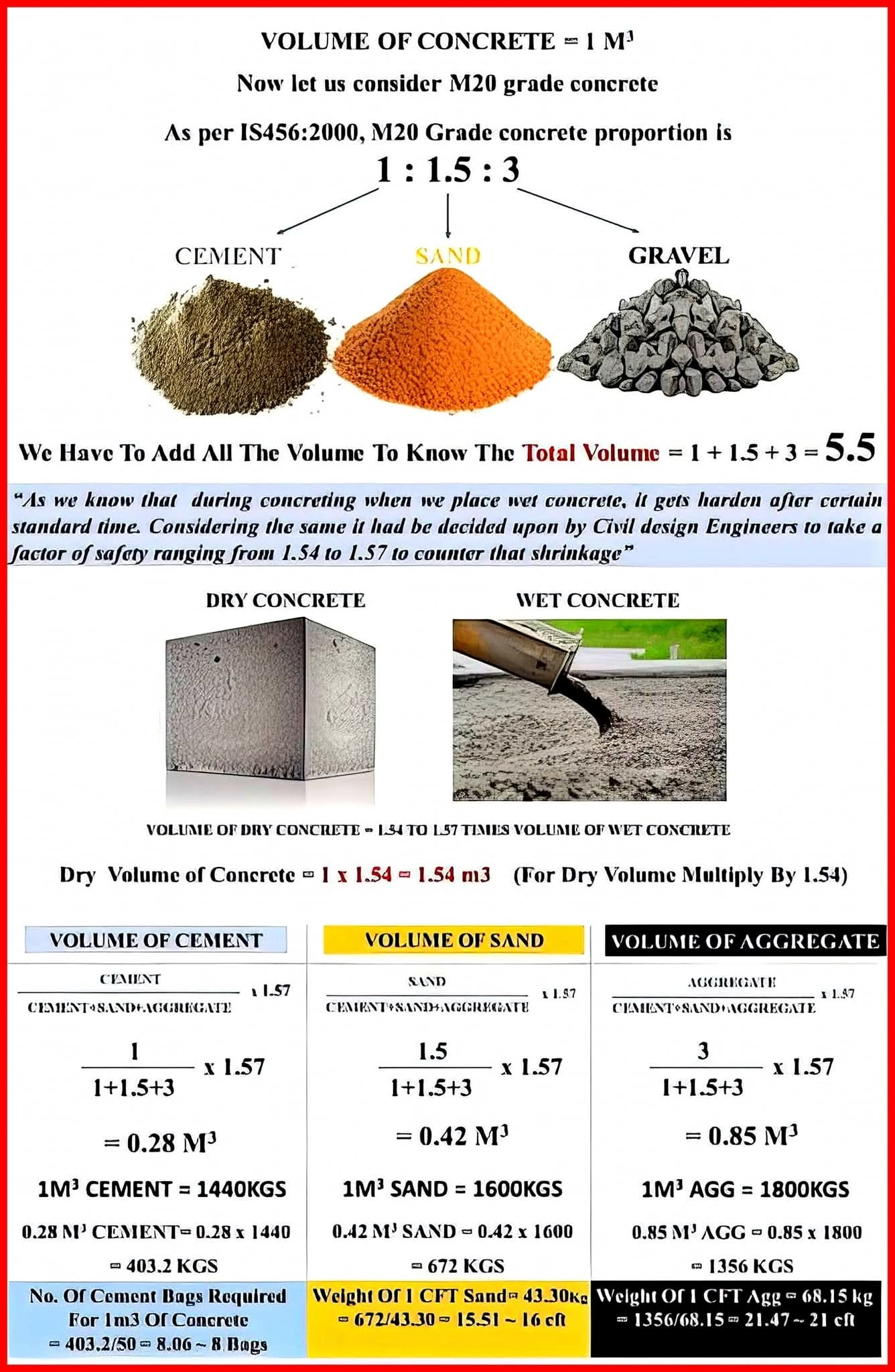
  • This infographic explains how to calculate the exact amounts of cement, sand, and gravel needed for M20 grade concrete.

    The process starts with the standard M20 mix proportion of 1:1.5:3 (1 part cement, 1.5 parts sand, and 3 parts gravel). A crucial step often overlooked is accounting for the shrinkage that occurs when wet concrete hardens. To compensate for this volume loss, civil engineers apply a safety factor (typically 1.54 to 1.57) to the desired wet volume to determine the required dry volume of materials.

    Following the calculations in the image to get 1 cubic meter of finished concrete, you would need:

    Cement: 0.28 m³, or approximately 8 bags.

    Sand: 0.42 m³, or about 16 cubic feet.

    Aggregate (Gravel): 0.85 m³, or about 21 cubic feet.

    This is a fantastic reference for getting your mix proportions right every time!

    #CivilEngineering #Construction #ConcreteMix #BuildingTips #DIYProjects #Engineering #M20Concrete #ConstructionMath #BuildingMaterials
    This infographic explains how to calculate the exact amounts of cement, sand, and gravel needed for M20 grade concrete. The process starts with the standard M20 mix proportion of 1:1.5:3 (1 part cement, 1.5 parts sand, and 3 parts gravel). A crucial step often overlooked is accounting for the shrinkage that occurs when wet concrete hardens. To compensate for this volume loss, civil engineers apply a safety factor (typically 1.54 to 1.57) to the desired wet volume to determine the required dry volume of materials. Following the calculations in the image to get 1 cubic meter of finished concrete, you would need: Cement: 0.28 m³, or approximately 8 bags. Sand: 0.42 m³, or about 16 cubic feet. Aggregate (Gravel): 0.85 m³, or about 21 cubic feet. This is a fantastic reference for getting your mix proportions right every time! #CivilEngineering #Construction #ConcreteMix #BuildingTips #DIYProjects #Engineering #M20Concrete #ConstructionMath #BuildingMaterials
    0 Comments 0 Shares 8370 Views
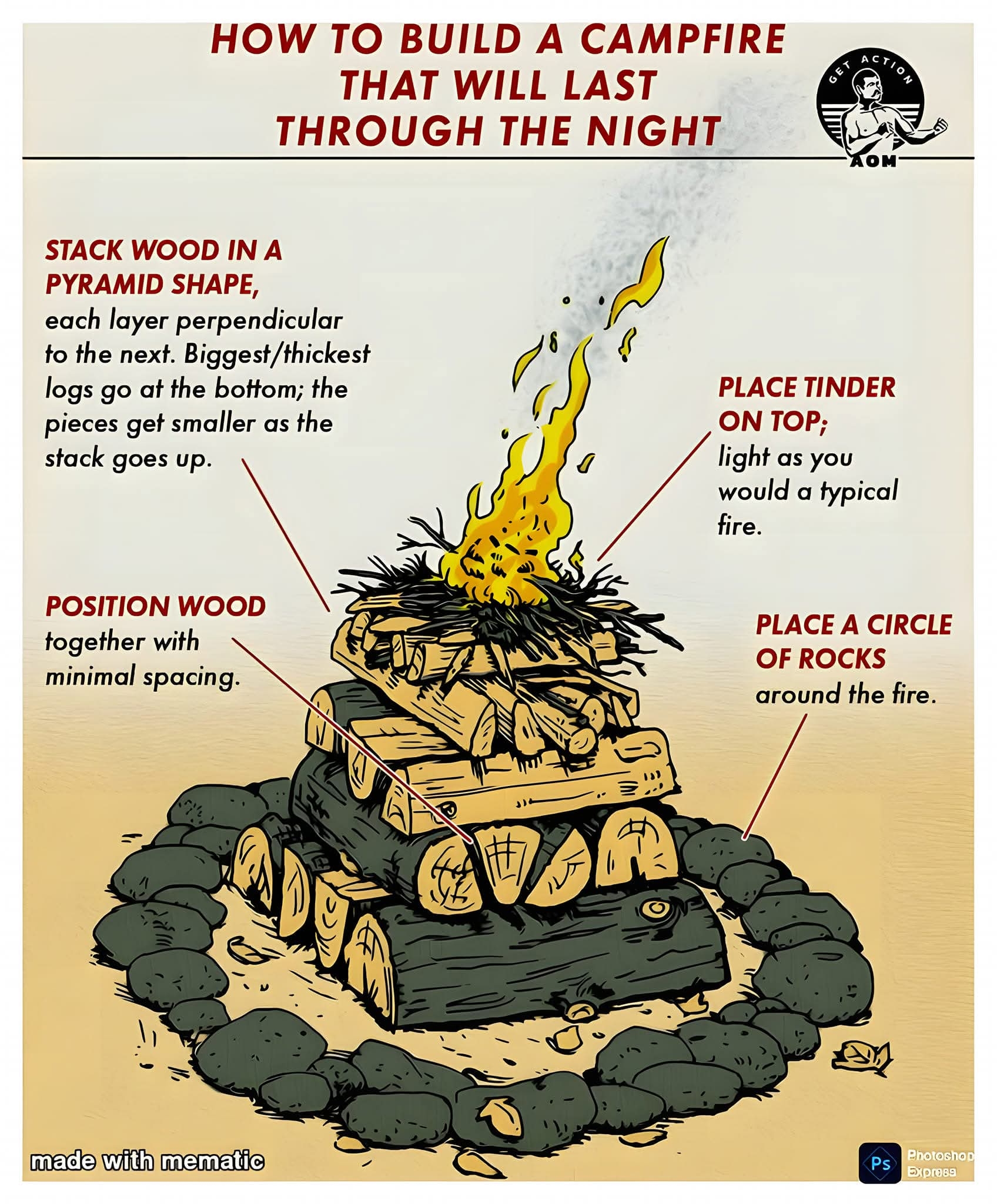
  • How to Build a Campfire That Lasts Through the Night

    This guide shows a pyramid-style campfire, perfect for keeping you warm and safe all night long. Here’s the breakdown:

    ---

    Step-by-Step Instructions:

    1. Stack Wood in a Pyramid Shape

    Start with the biggest logs at the bottom.

    Place each layer perpendicular to the last (like building blocks).

    Use smaller and lighter pieces as you go up.

    2. Place Tinder on Top

    Use dry leaves, twigs, or paper as tinder.

    Light it just like a regular fire; the flames will work their way down through the layers.

    3. Position Wood with Minimal Spacing

    Keep wood close together to maintain a steady burn.

    Leave just enough room for air circulation.

    4. Place a Circle of Rocks Around the Fire

    Acts as a fire barrier for safety.

    Helps reflect heat inward and keep the fire contained.

    ---

    Pro Tips:

    Always build your fire on bare soil or sand, never on dry grass.

    Keep a bucket of water or sand nearby for emergencies.

    Never leave the fire unattended, even with rock barriers.

    ---

    #CampfireTips #OutdoorSkills #Bushcraft #CampingLife #SurvivalTips #WildernessLiving #FireMaking #AdventureReady #BackpackingSkills #CampSmart
    🔥⛺ How to Build a Campfire That Lasts Through the Night 🌲✨ This guide shows a pyramid-style campfire, perfect for keeping you warm and safe all night long. Here’s the breakdown: --- 🔥 Step-by-Step Instructions: 1. Stack Wood in a Pyramid Shape Start with the biggest logs at the bottom. Place each layer perpendicular to the last (like building blocks). Use smaller and lighter pieces as you go up. 2. Place Tinder on Top Use dry leaves, twigs, or paper as tinder. Light it just like a regular fire; the flames will work their way down through the layers. 3. Position Wood with Minimal Spacing Keep wood close together to maintain a steady burn. Leave just enough room for air circulation. 4. Place a Circle of Rocks Around the Fire Acts as a fire barrier for safety. Helps reflect heat inward and keep the fire contained. --- 🌟 Pro Tips: Always build your fire on bare soil or sand, never on dry grass. Keep a bucket of water or sand nearby for emergencies. Never leave the fire unattended, even with rock barriers. --- #CampfireTips #OutdoorSkills #Bushcraft #CampingLife #SurvivalTips #WildernessLiving #FireMaking #AdventureReady #BackpackingSkills #CampSmart
    0 Comments 0 Shares 5864 Views
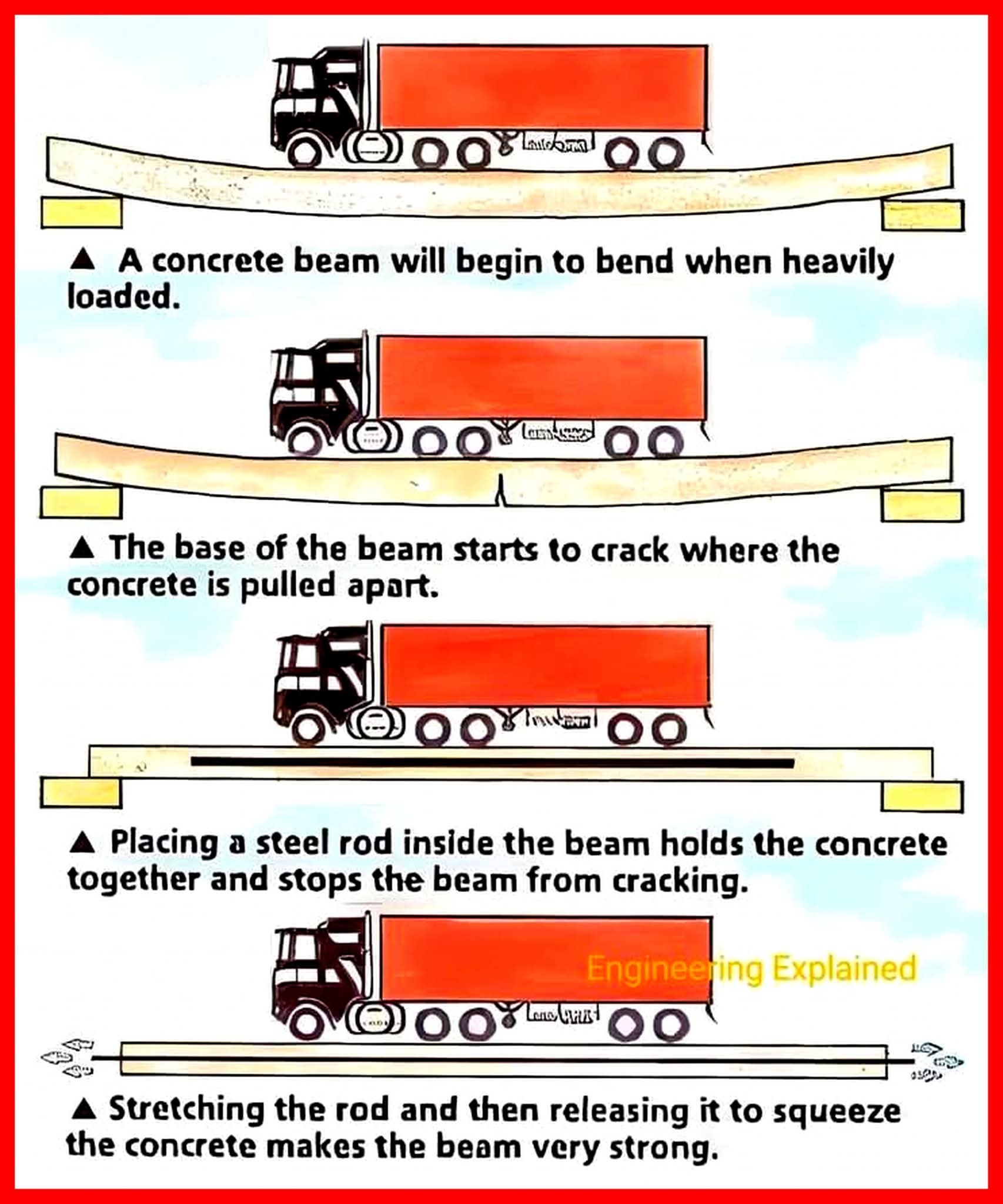
  • Step-by-step explanation of how reinforced and prestressed concrete beams work under heavy loads. Concrete alone is strong in compression but weak in tension, which is why reinforcement is crucial for structural safety and durability.

    Concrete Beam Under Load: A plain concrete beam bends when a heavy load (like a truck) is applied, showing its natural weakness under tension.
    Cracking at the Base: The base of the beam begins to crack because concrete is being pulled apart due to tensile stress.
    Reinforced with Steel Rods: By placing a steel rod inside the beam, the reinforcement holds the concrete together, preventing cracks and providing tensile strength.
    Prestressed Concrete: When the steel rod is stretched before pouring concrete and then released, it compresses the beam. This pre-compression counters the tensile forces when loads are applied, making the beam significantly stronger and more durable.

    This is why modern construction uses reinforced and prestressed concrete beams in bridges, buildings, and highways, ensuring safety and longevity under massive loads.

    #EngineeringExplained #CivilEngineering #ConcreteStructures #StructuralEngineering #ReinforcedConcrete #PrestressedConcrete #ConstructionTech
    Step-by-step explanation of how reinforced and prestressed concrete beams work under heavy loads. Concrete alone is strong in compression but weak in tension, which is why reinforcement is crucial for structural safety and durability. 1️⃣ Concrete Beam Under Load: A plain concrete beam bends when a heavy load (like a truck) is applied, showing its natural weakness under tension. 2️⃣ Cracking at the Base: The base of the beam begins to crack because concrete is being pulled apart due to tensile stress. 3️⃣ Reinforced with Steel Rods: By placing a steel rod inside the beam, the reinforcement holds the concrete together, preventing cracks and providing tensile strength. 4️⃣ Prestressed Concrete: When the steel rod is stretched before pouring concrete and then released, it compresses the beam. This pre-compression counters the tensile forces when loads are applied, making the beam significantly stronger and more durable. 👉 This is why modern construction uses reinforced and prestressed concrete beams in bridges, buildings, and highways, ensuring safety and longevity under massive loads. 🚛🏗️ #EngineeringExplained #CivilEngineering #ConcreteStructures #StructuralEngineering #ReinforcedConcrete #PrestressedConcrete #ConstructionTech
    0 Comments 0 Shares 9254 Views