



-
1 people like this
-
267 Posts
-
167 Photos
-
1 Videos
-
Reviews
-
Education
Search

 Arabic
 French
 Spanish
 Portuguese
 Deutsch
 Turkish
 Dutch
Dutch
 Italiano
 Russian
 Romaian
 Portuguese (Brazil)
 Greek
Greek
Recent Updates
-
https://x.com/Fuel_YourGrowth/status/21125393309716316480 Comments 0 Shares 267 Views
-
https://x.com/CompoundingW/status/21122974873022796360 Comments 0 Shares 395 Views
-
https://x.com/DIGIMINAL/status/21122506788697051560 Comments 0 Shares 242 Views
-
https://x.com/AlwaysKeepL/status/21122063870236020220 Comments 0 Shares 38 Views
-
Important Methods in Python You Should Know
Working with Python collections becomes much easier when you understand their built-in methods.
Here’s a quick cheat sheet covering three essential data structures:
1. Set
add() — Add an element
discard() — Remove an element without raising an error if it is missing
union() — Combine sets
intersection() — Find common elements
issubset() — Check whether a set is a subset
2. Dictionary
get() — Retrieve a value safely
keys() — Access dictionary keys
values() — Access dictionary values
items() — Get key-value pairs
update() — Add or update entries
3. List
append() — Add an element at the end
extend() — Add multiple elements
insert() — Add an element at a specific position
sort() — Sort elements
reverse() — Reverse the list
Python Tip: Choose the right data structure for your task. Lists are great for ordered collections, sets for unique elements, and dictionaries for key-value mappings.
Save this cheat sheet for your next Python project!
Important Methods in Python You Should Know Working with Python collections becomes much easier when you understand their built-in methods. Here’s a quick cheat sheet covering three essential data structures: 1. Set add() — Add an element discard() — Remove an element without raising an error if it is missing union() — Combine sets intersection() — Find common elements issubset() — Check whether a set is a subset 2. Dictionary get() — Retrieve a value safely keys() — Access dictionary keys values() — Access dictionary values items() — Get key-value pairs update() — Add or update entries 3. List append() — Add an element at the end extend() — Add multiple elements insert() — Add an element at a specific position sort() — Sort elements reverse() — Reverse the list Python Tip: Choose the right data structure for your task. Lists are great for ordered collections, sets for unique elements, and dictionaries for key-value mappings. Save this cheat sheet for your next Python project!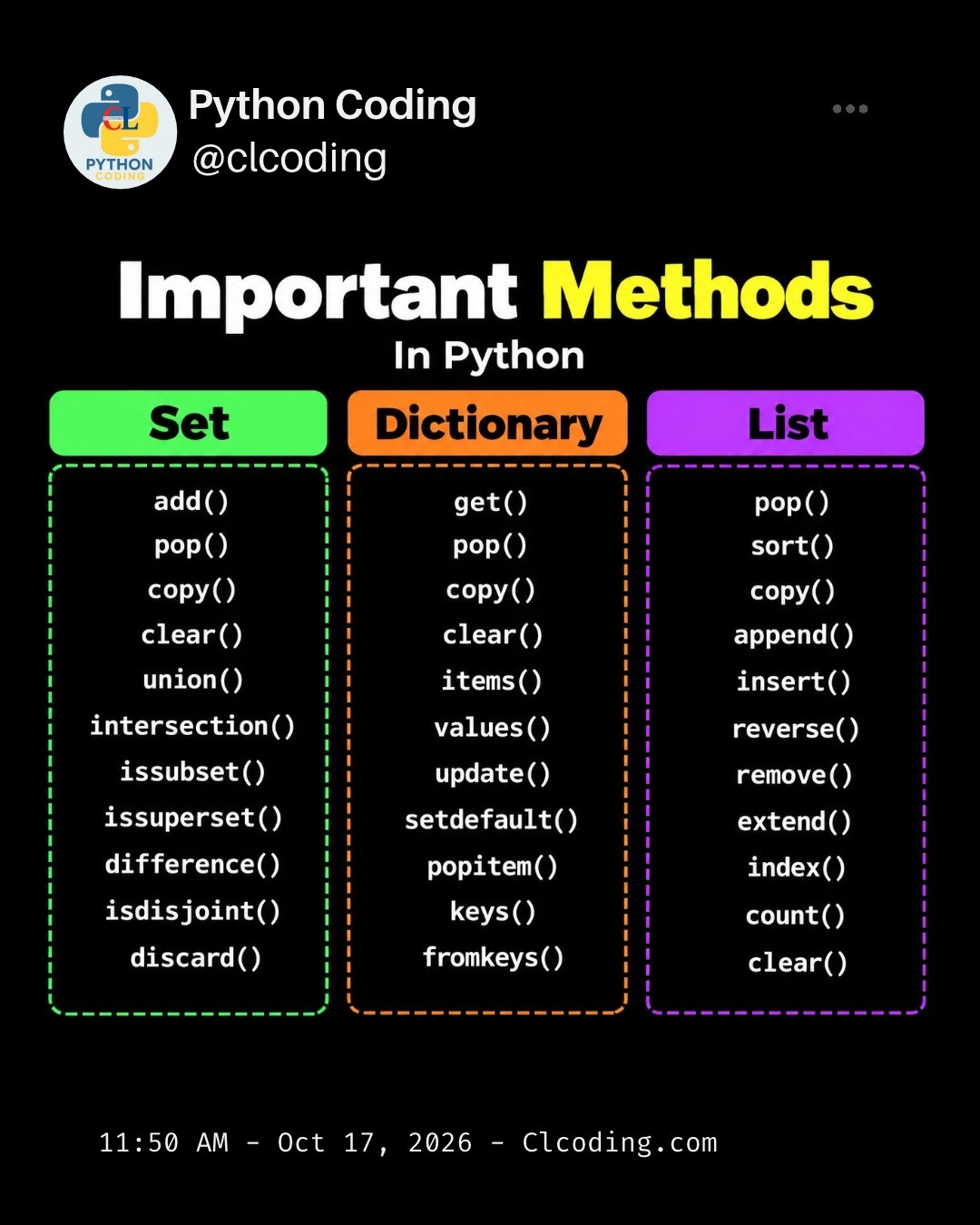 0 Comments 0 Shares 503 Views
 -
Python: One Language, Infinite Possibilities
Python is more than just a programming language. It opens doors to multiple career paths and real-world applications.
Here’s what you can build with Python:
Web Development: Django, Flask
Data Analysis: Pandas, NumPy
Machine Learning: Scikit-learn
Automation: Python scripting
Web Scraping: Beautiful Soup
Data Visualization: Matplotlib, Seaborn
Database Management: SQLite, MySQL
Deep Learning & AI: TensorFlow, PyTorch
Desktop Applications: Tkinter, PyQt
Game Development: Pygame
API Development: FastAPI
IoT & Robotics: MicroPython
Cybersecurity: Security tools and automation
You don't need to learn everything at once. Start with Python fundamentals, choose your area of interest, and build real-world projects.
Your next big project could start with Python.
Learn, practice, and grow with CLCODING.
Which Python application do you want to explore first?Python: One Language, Infinite Possibilities Python is more than just a programming language. It opens doors to multiple career paths and real-world applications. Here’s what you can build with Python: Web Development: Django, Flask Data Analysis: Pandas, NumPy Machine Learning: Scikit-learn Automation: Python scripting Web Scraping: Beautiful Soup Data Visualization: Matplotlib, Seaborn Database Management: SQLite, MySQL Deep Learning & AI: TensorFlow, PyTorch Desktop Applications: Tkinter, PyQt Game Development: Pygame API Development: FastAPI IoT & Robotics: MicroPython Cybersecurity: Security tools and automation You don't need to learn everything at once. Start with Python fundamentals, choose your area of interest, and build real-world projects. Your next big project could start with Python. Learn, practice, and grow with CLCODING. Which Python application do you want to explore first?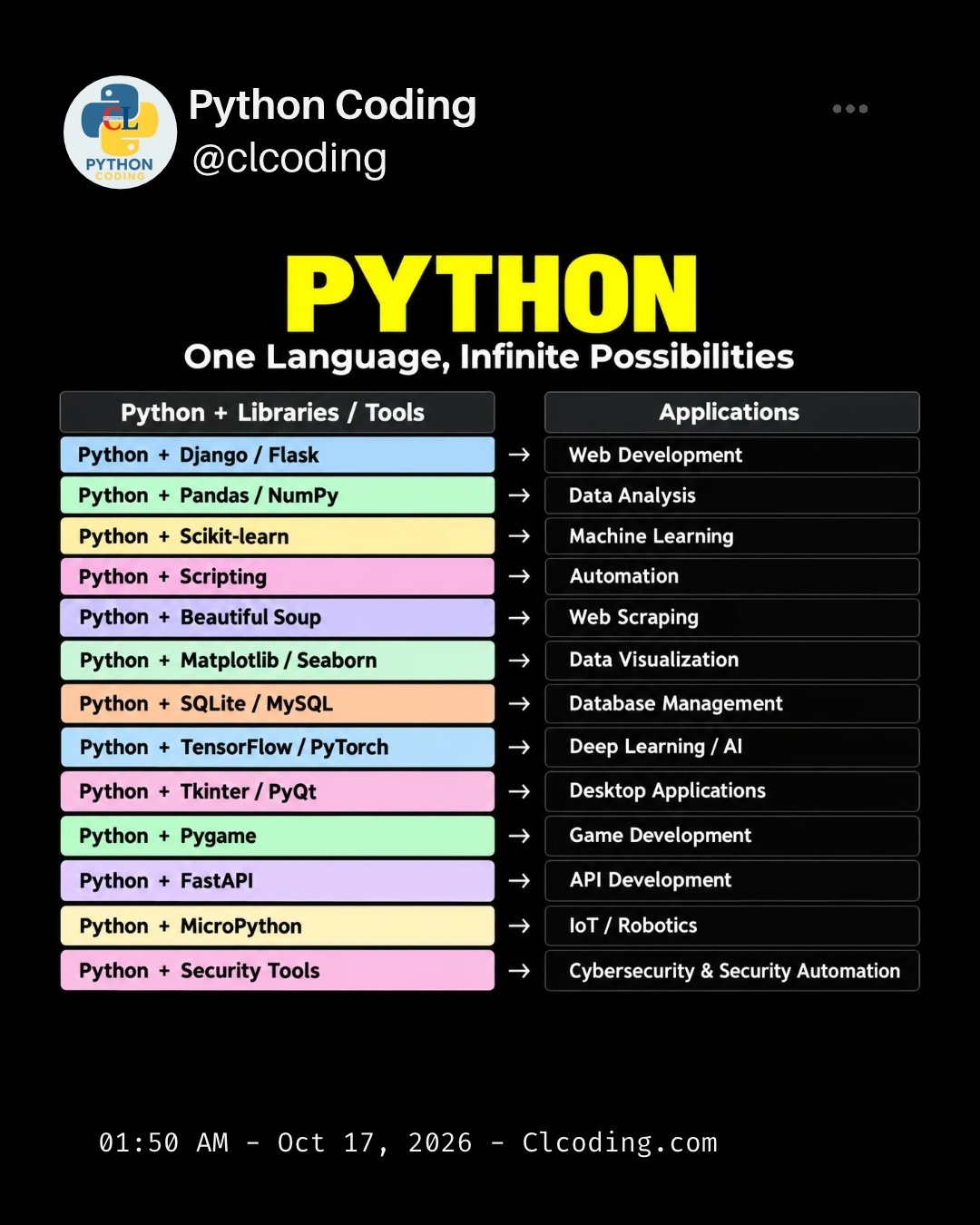 0 Comments 0 Shares 598 Views
 -
Iconic Tech Failures America Still Remembers
Technology history is filled with ambitious inventions that failed to meet expectations. From the Ford Edsel to Google Glass and the Amazon Fire Phone, these products teach valuable lessons about timing, pricing, innovation, and customer needs. Every failure reminds companies that success requires understanding people and adapting to change.
#TechHistory #Innovation #Technology #TechFailures #GoogleGlass #AmazonFirePhone #GadgetsIconic Tech Failures America Still Remembers 📱💻 Technology history is filled with ambitious inventions that failed to meet expectations. From the Ford Edsel to Google Glass and the Amazon Fire Phone, these products teach valuable lessons about timing, pricing, innovation, and customer needs. Every failure reminds companies that success requires understanding people and adapting to change. #TechHistory #Innovation #Technology #TechFailures #GoogleGlass #AmazonFirePhone #Gadgets 0 Comments 0 Shares 427 Views
 -
My grandmother never owned a single fancy cleaning product or kitchen gadget, yet her home always smelled fresh and nothing in her kitchen ever went to waste.
She simply knew the little tricks that were passed down through generations.
She rubbed half a lemon with salt over the cutting board to keep it fresh. A bowl of baking soda in the fridge kept odours away. A wooden spoon laid across the pot stopped it from boiling over. A slice of bread kept the brown sugar soft, and a splash of vinegar left the windows sparkling.
These simple, natural habits have stood the test of time. Sometimes the old ways really are the best ways.
#GrandmasTips #NaturalLiving #HomeHacks #OldFashionedWisdom #HealthyHomeMy grandmother never owned a single fancy cleaning product or kitchen gadget, yet her home always smelled fresh and nothing in her kitchen ever went to waste. 👵 She simply knew the little tricks that were passed down through generations. She rubbed half a lemon with salt over the cutting board to keep it fresh. A bowl of baking soda in the fridge kept odours away. A wooden spoon laid across the pot stopped it from boiling over. A slice of bread kept the brown sugar soft, and a splash of vinegar left the windows sparkling. These simple, natural habits have stood the test of time. Sometimes the old ways really are the best ways. 💛 #GrandmasTips #NaturalLiving #HomeHacks #OldFashionedWisdom #HealthyHome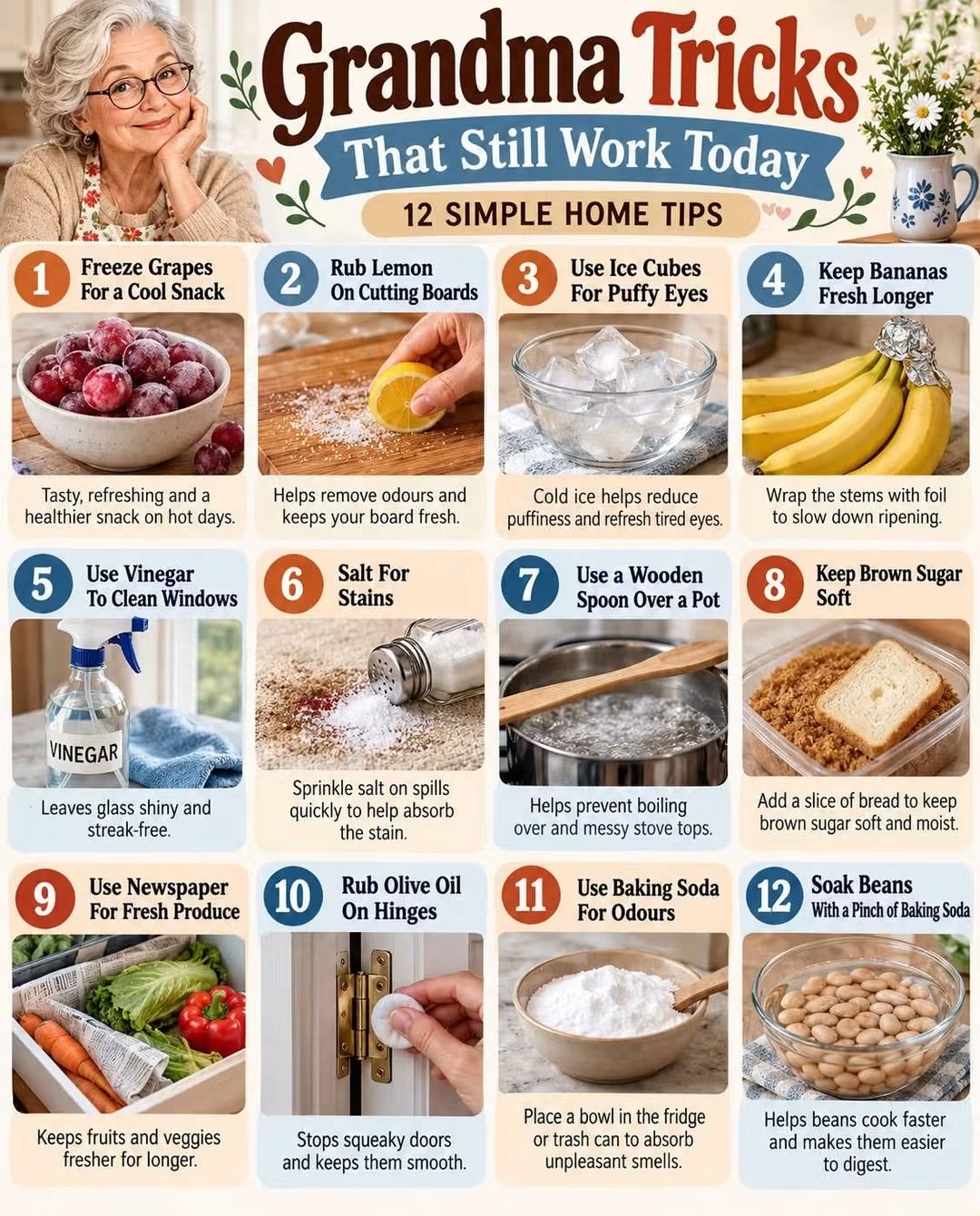 0 Comments 0 Shares 381 Views
More Stories