


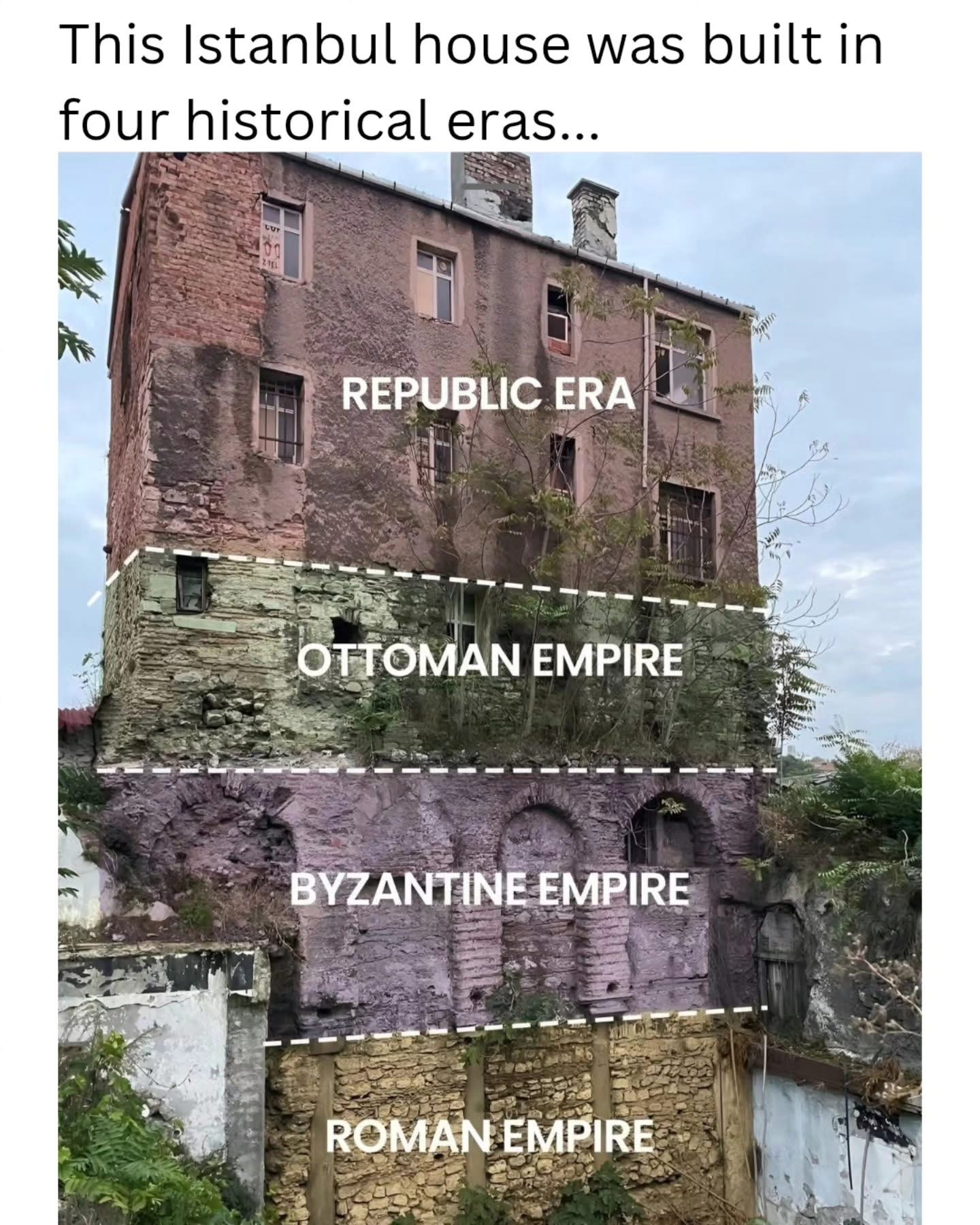
This modest building, now a small landmark in Istanbul’s urban fabric, exposes the city’s long memory through stone and brick.
The Roman cistern at its foundation likely formed part of the city’s late antique water system, engineered to secure Constantinople against siege and drought, and its survival beneath later construction reflects both Roman durability and centuries of accidental preservation.
When the city became the Byzantine capital, the space above was reorganized with brick arches and vaults, elements typical of commercial or storage structures tied to nearby forums and ports, where goods, taxes, and people circulated through the imperial economy.
After the Ottoman conquest, the structure was not erased but adapted. Walls were repaired, openings reshaped, and materials reused in a practical continuity that valued function over monumentality. Subtle changes in masonry and mortar reveal these interventions, while early Republican era fixes introduced modern materials and techniques, prioritizing stability rather than historical purity. Each layer reflects a different relationship with the past: Roman ambition, Byzantine administration, Ottoman pragmatism, and modern necessity.
The Roman cistern at its foundation likely formed part of the city’s late antique water system, engineered to secure Constantinople against siege and drought, and its survival beneath later construction reflects both Roman durability and centuries of accidental preservation.
When the city became the Byzantine capital, the space above was reorganized with brick arches and vaults, elements typical of commercial or storage structures tied to nearby forums and ports, where goods, taxes, and people circulated through the imperial economy.
After the Ottoman conquest, the structure was not erased but adapted. Walls were repaired, openings reshaped, and materials reused in a practical continuity that valued function over monumentality. Subtle changes in masonry and mortar reveal these interventions, while early Republican era fixes introduced modern materials and techniques, prioritizing stability rather than historical purity. Each layer reflects a different relationship with the past: Roman ambition, Byzantine administration, Ottoman pragmatism, and modern necessity.
This modest building, now a small landmark in Istanbul’s urban fabric, exposes the city’s long memory through stone and brick.
The Roman cistern at its foundation likely formed part of the city’s late antique water system, engineered to secure Constantinople against siege and drought, and its survival beneath later construction reflects both Roman durability and centuries of accidental preservation.
When the city became the Byzantine capital, the space above was reorganized with brick arches and vaults, elements typical of commercial or storage structures tied to nearby forums and ports, where goods, taxes, and people circulated through the imperial economy.
After the Ottoman conquest, the structure was not erased but adapted. Walls were repaired, openings reshaped, and materials reused in a practical continuity that valued function over monumentality. Subtle changes in masonry and mortar reveal these interventions, while early Republican era fixes introduced modern materials and techniques, prioritizing stability rather than historical purity. Each layer reflects a different relationship with the past: Roman ambition, Byzantine administration, Ottoman pragmatism, and modern necessity.
0 Σχόλια
0 Μοιράστηκε
1365 Views

 English
 Arabic
 French
 Spanish
 Portuguese
 Deutsch
 Turkish
 Dutch
Dutch
 Italiano
 Russian
 Romaian
 Portuguese (Brazil)