


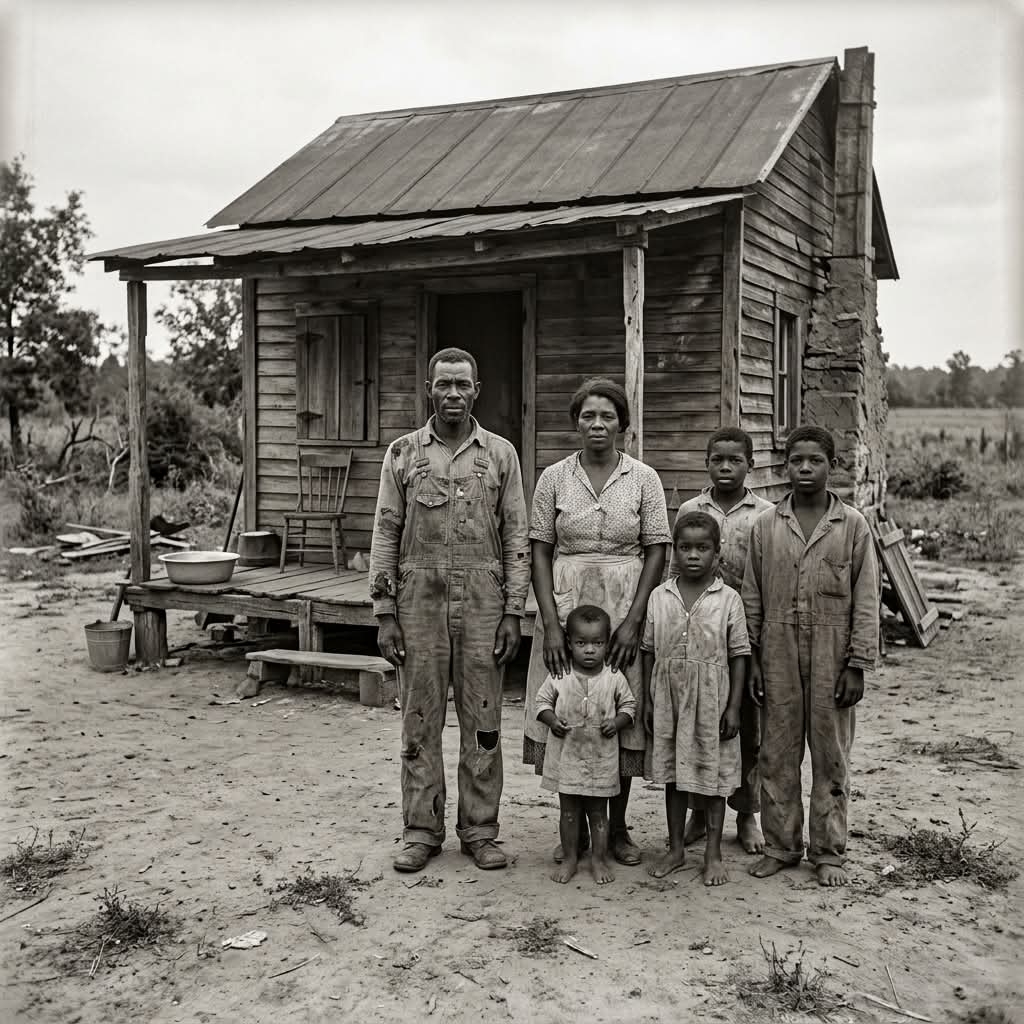
In 1932, a powerful photograph captured a family of tenant farmers standing outside their modest one-room cabin in Greene County, Alabama. The image, now preserved in historical collections, offers a revealing glimpse into the hardships experienced by countless rural families during the Great Depression. The small cabin, with its weathered wooden walls and narrow front porch, represented the endurance and resilience required to survive through years of economic uncertainty and hardship.
Tenant farming remained widespread throughout the South during this era, with landowners supplying farmland and basic tools while farming families worked in exchange for a portion of the crops they produced. For many families, including this one, the arrangement often resulted in ongoing debt and very little independence. Life under these conditions demanded exhausting labor, and families remained deeply dependent on the land while possessing few resources and almost no control over their future.
Despite the visible signs of struggle shown in their clothing and posture, the expressions on the family’s faces still reflect quiet dignity, patience, and strength. The small cabin behind them, though simple and worn, served as a place of shelter, unity, and survival where family members depended on one another through difficult years. More than simply documenting poverty, this photograph stands as a tribute to the determination of those who endured the Great Depression, preserving both their hardships and the enduring spirit that carried them forward.
In 1932, a powerful photograph captured a family of tenant farmers standing outside their modest one-room cabin in Greene County, Alabama. The image, now preserved in historical collections, offers a revealing glimpse into the hardships experienced by countless rural families during the Great Depression. The small cabin, with its weathered wooden walls and narrow front porch, represented the endurance and resilience required to survive through years of economic uncertainty and hardship.
Tenant farming remained widespread throughout the South during this era, with landowners supplying farmland and basic tools while farming families worked in exchange for a portion of the crops they produced. For many families, including this one, the arrangement often resulted in ongoing debt and very little independence. Life under these conditions demanded exhausting labor, and families remained deeply dependent on the land while possessing few resources and almost no control over their future.
Despite the visible signs of struggle shown in their clothing and posture, the expressions on the family’s faces still reflect quiet dignity, patience, and strength. The small cabin behind them, though simple and worn, served as a place of shelter, unity, and survival where family members depended on one another through difficult years. More than simply documenting poverty, this photograph stands as a tribute to the determination of those who endured the Great Depression, preserving both their hardships and the enduring spirit that carried them forward.
0 Комментарии
0 Поделились
27 Просмотры

 English
 Arabic
 French
 Spanish
 Portuguese
 Deutsch
 Turkish
 Dutch
 Italiano
 Romaian
 Portuguese (Brazil)
 Greek