


In 1847, Missouri passed a law that prohibited teaching Black people, both enslaved and free, to read or write. In St. Louis, this forced Reverend John Berry Meachum to close the school he had been operating in the basement of his church. Rather than accept the restriction, Meachum found an unusual way to continue teaching. He moved the classroom onto a steamboat anchored in the Mississippi River, beyond the reach of Missouri's state jurisdiction.
The school became known as the Floating Freedom School. Meachum equipped the vessel with desks, chairs, and a library, while students were carried from the St. Louis shore to the boat in smaller vessels. The school served both free and enslaved Black students and educated hundreds of children during the 1840s and 1850s. One of its students was James Milton Turner, who later became an important Black educator and political leader in Missouri after the Civil War. [Steamship Historical Society]
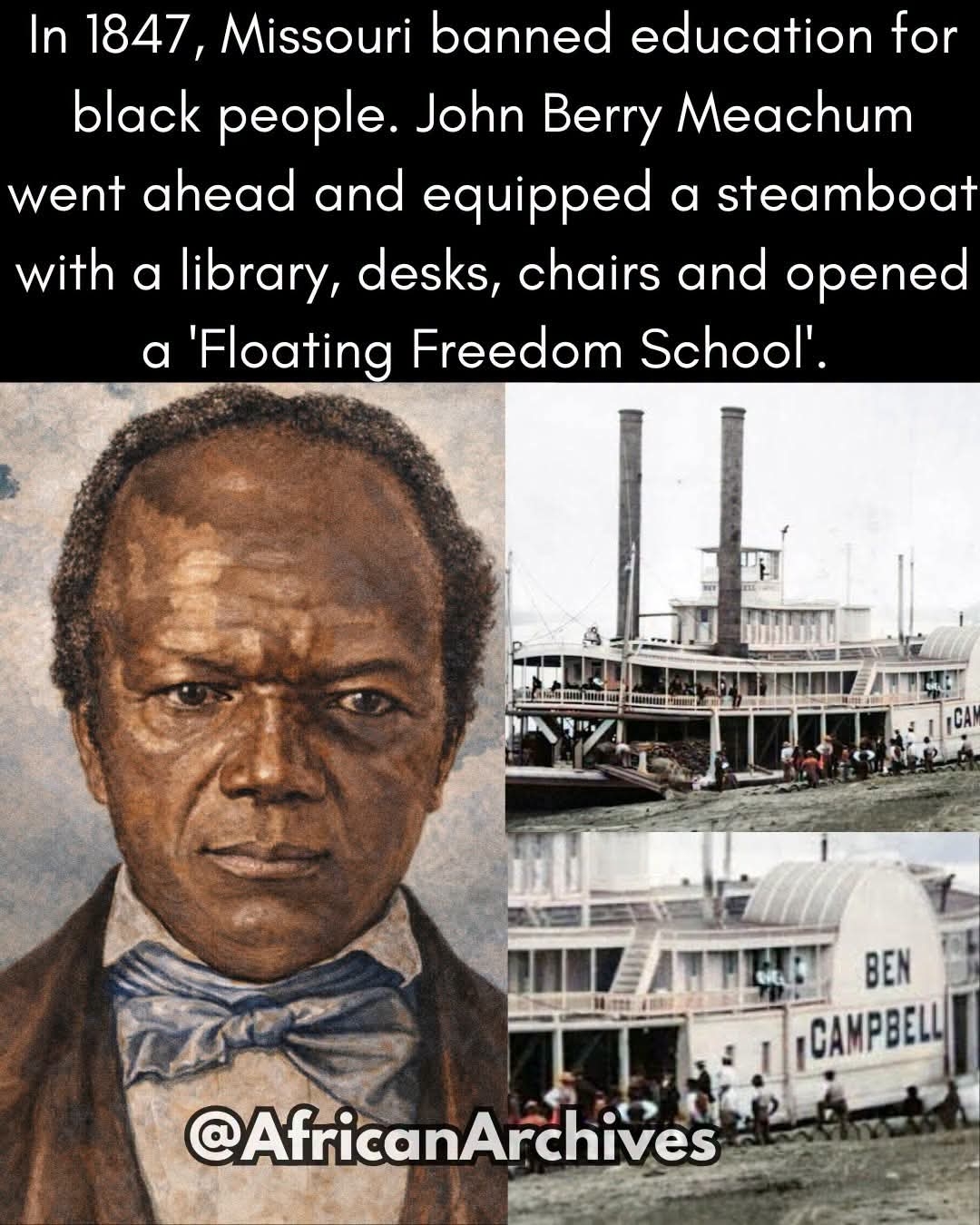
The image often shared with this story identifies the boat as the *Ben Campbell*, but historians caution that the exact vessel used as the Floating Freedom School is not established with complete certainty. The *Ben Campbell* is commonly associated with the school, but surviving historical evidence leaves some uncertainty about the identification.
Meachum's story reveals how education itself became an act of resistance under slavery. Missouri could criminalize the classroom, but it could not easily extinguish the determination of Black families and educators to pursue literacy. The Floating Freedom School was more than a place to learn. It represented a deliberate effort to preserve access to knowledge when the law was being used to take that opportunity away.
#BlackHistory #BlackEducation
In 1847, Missouri passed a law that prohibited teaching Black people, both enslaved and free, to read or write. In St. Louis, this forced Reverend John Berry Meachum to close the school he had been operating in the basement of his church. Rather than accept the restriction, Meachum found an unusual way to continue teaching. He moved the classroom onto a steamboat anchored in the Mississippi River, beyond the reach of Missouri's state jurisdiction.
The school became known as the Floating Freedom School. Meachum equipped the vessel with desks, chairs, and a library, while students were carried from the St. Louis shore to the boat in smaller vessels. The school served both free and enslaved Black students and educated hundreds of children during the 1840s and 1850s. One of its students was James Milton Turner, who later became an important Black educator and political leader in Missouri after the Civil War. [Steamship Historical Society]
The image often shared with this story identifies the boat as the *Ben Campbell*, but historians caution that the exact vessel used as the Floating Freedom School is not established with complete certainty. The *Ben Campbell* is commonly associated with the school, but surviving historical evidence leaves some uncertainty about the identification.
Meachum's story reveals how education itself became an act of resistance under slavery. Missouri could criminalize the classroom, but it could not easily extinguish the determination of Black families and educators to pursue literacy. The Floating Freedom School was more than a place to learn. It represented a deliberate effort to preserve access to knowledge when the law was being used to take that opportunity away.
#BlackHistory #BlackEducation
0 Comentários
0 Compartilhamentos
174 Visualizações

 English
 Arabic
 French
 Spanish
 Deutsch
 Turkish
 Dutch
 Italiano
 Russian
 Romaian
 Portuguese (Brazil)
 Greek