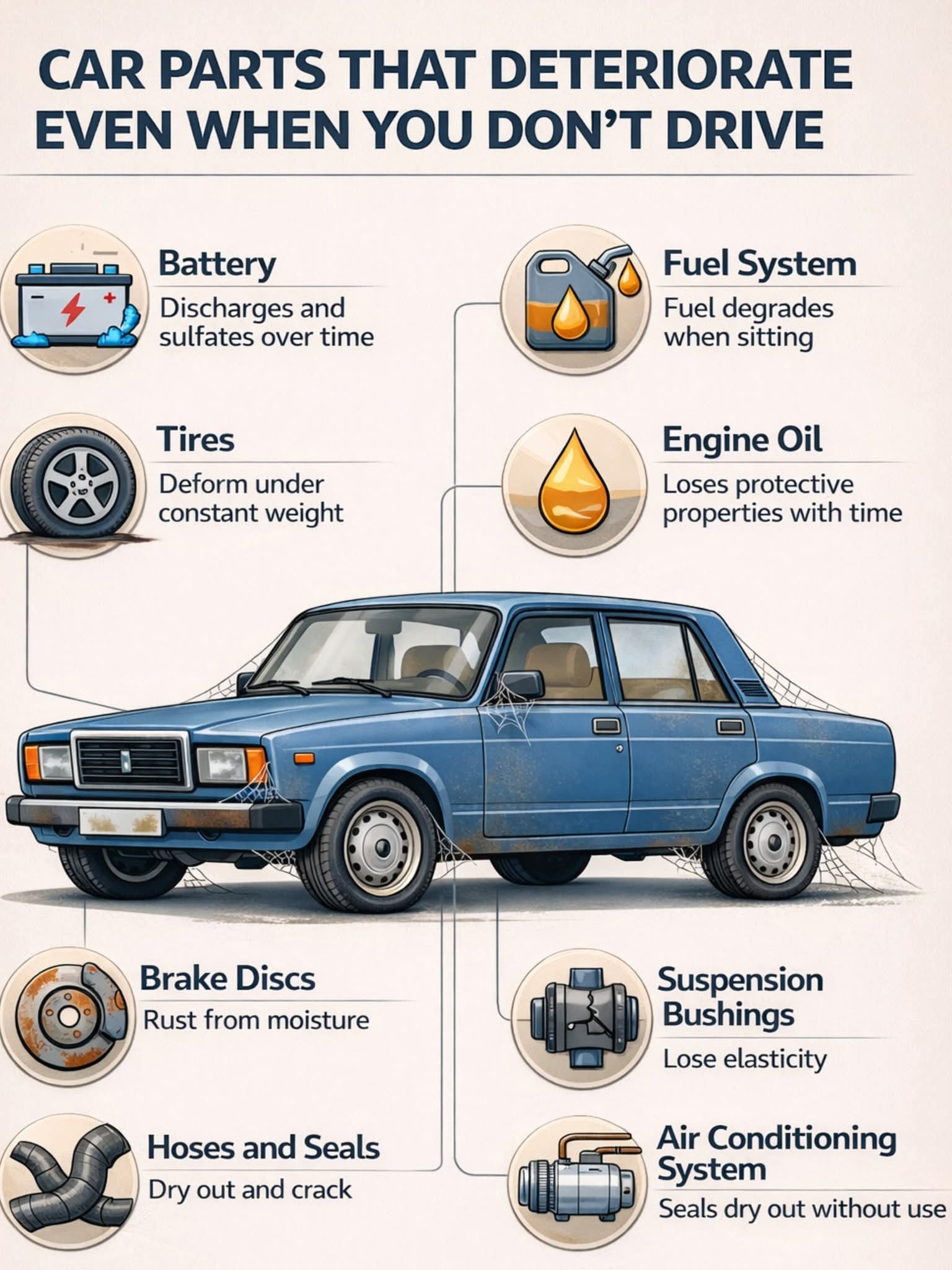
• Why Letting a Car Sit Too Long Can Hurt It

    The battery slowly dies
    Even when parked, the battery loses charge over time. Leave it too long, and you may come back to a car that won’t start at all.

    Tires lose shape
    Staying in the same position for weeks can cause flat spots. The next drive may feel bumpy or unstable.

    Brakes begin to rust
    Moisture builds up on the brake discs, creating rust. This can reduce braking performance or cause annoying noises.

    Hoses and seals dry out
    Rubber parts need movement and fluid circulation. When the car sits, they can crack, harden, or leak.

    Fluids lose effectiveness
    Fuel and engine oil degrade with time. Old fuel can cause starting issues, and worn-out oil won’t protect the engine properly.

    Relatable mistake: many people think leaving the car parked keeps it “like new.” In reality, cars are built to move, and a short drive every week often keeps them healthier than months of sitting still.
    Why Letting a Car Sit Too Long Can Hurt It ⏳ 1️⃣ The battery slowly dies Even when parked, the battery loses charge over time. Leave it too long, and you may come back to a car that won’t start at all. 2️⃣ Tires lose shape Staying in the same position for weeks can cause flat spots. The next drive may feel bumpy or unstable. 3️⃣ Brakes begin to rust Moisture builds up on the brake discs, creating rust. This can reduce braking performance or cause annoying noises. 4️⃣ Hoses and seals dry out Rubber parts need movement and fluid circulation. When the car sits, they can crack, harden, or leak. 5️⃣ Fluids lose effectiveness Fuel and engine oil degrade with time. Old fuel can cause starting issues, and worn-out oil won’t protect the engine properly. Relatable mistake: many people think leaving the car parked keeps it “like new.” In reality, cars are built to move, and a short drive every week often keeps them healthier than months of sitting still.
    0 Commenti 0 condivisioni 1434 Views
  • Automobile tires have undergone a remarkable transformation over the last century, evolving from simple rubber coverings into highly engineered components critical for safety, comfort, performance, and efficiency. This evolution reflects changes in vehicle design, road conditions, driving speeds, and advances in material science.

    In the early 1900s and 1920s, tires were narrow, tall, and often mounted on spoked wheels. These early tyres were made from natural rubber with cotton fabric plies and had smooth or lightly grooved surfaces. They were designed mainly to cope with rough, unpaved roads and low vehicle speeds. Durability was limited, punctures were common, and ride comfort was basic. Bias-ply construction dominated this era, where fabric layers were laid diagonally across each other, making tires stiff and prone to heat buildup.

    By the 1930s and 1940s, tire designs became slightly wider and stronger. Rubber compounds improved, and tread patterns became more defined to enhance grip on wet and muddy roads. During this period, vehicles grew heavier and faster, especially due to wartime engineering advances, pushing tire manufacturers to focus more on load capacity and reliability.

    The 1950s marked a major visual and technical shift with the introduction of whitewall tyres, symbolizing style and luxury. More importantly, tire construction continued to improve, offering better comfort and longer life. In the late 1940s and 1950s, radial tire technology was developed, though it gained widespread adoption slightly later. Radial tires used steel belts laid perpendicular to the direction of travel, significantly improving grip, fuel efficiency, and tread life.

    During the 1960s and 1970s, radial tires became mainstream globally. Tires grew wider, and tread designs became more aggressive to support higher speeds and better cornering. Performance-oriented tires emerged alongside off-road and all-terrain tires, reflecting the rise of sports cars and utility vehicles. Safety, heat resistance, and handling became central design goals.

    By the 1980s and 1990s, tire technology advanced rapidly. Low-profile tyres paired with alloy wheels became popular, improving handling and aesthetics. Rubber compounds were enhanced using synthetic materials, silica, and carbon black to balance grip, durability, and rolling resistance. Specialized tires such as winter tires, high-performance summer tires, and touring tires became common, each designed for specific driving conditions.

    From the 2000s onward, tires evolved into highly specialized, technology-driven products. Modern tires feature advanced tread patterns for noise reduction, water dispersion, and improved braking. Run-flat tires allow limited driving even after punctures, while tubeless designs became standard for safety and convenience. Sensors for tire pressure monitoring systems (TPMS) were integrated to enhance safety.

    Today, tires are engineered with sustainability and efficiency in mind. There are eco-friendly tires designed to reduce rolling resistance and improve electric vehicle range, ultra-high-performance tires for sports cars, all-season tires for everyday use, off-road and mud-terrain tires for extreme conditions, and smart tires being developed with embedded sensors to monitor wear, temperature, and road conditions in real time.

    From simple rubber rings to intelligent, high-performance components, tire evolution mirrors the progress of the automobile itself focused on safety, efficiency, comfort, and innovation.

    #TireEvolution #AutomobileHistory #CarTechnology #RadialTires #VehicleSafety #AutomotiveEngineering #ModernTires #MobilityInnovation #Cars #Tire

    Automobile tires have undergone a remarkable transformation over the last century, evolving from simple rubber coverings into highly engineered components critical for safety, comfort, performance, and efficiency. This evolution reflects changes in vehicle design, road conditions, driving speeds, and advances in material science. In the early 1900s and 1920s, tires were narrow, tall, and often mounted on spoked wheels. These early tyres were made from natural rubber with cotton fabric plies and had smooth or lightly grooved surfaces. They were designed mainly to cope with rough, unpaved roads and low vehicle speeds. Durability was limited, punctures were common, and ride comfort was basic. Bias-ply construction dominated this era, where fabric layers were laid diagonally across each other, making tires stiff and prone to heat buildup. By the 1930s and 1940s, tire designs became slightly wider and stronger. Rubber compounds improved, and tread patterns became more defined to enhance grip on wet and muddy roads. During this period, vehicles grew heavier and faster, especially due to wartime engineering advances, pushing tire manufacturers to focus more on load capacity and reliability. The 1950s marked a major visual and technical shift with the introduction of whitewall tyres, symbolizing style and luxury. More importantly, tire construction continued to improve, offering better comfort and longer life. In the late 1940s and 1950s, radial tire technology was developed, though it gained widespread adoption slightly later. Radial tires used steel belts laid perpendicular to the direction of travel, significantly improving grip, fuel efficiency, and tread life. During the 1960s and 1970s, radial tires became mainstream globally. Tires grew wider, and tread designs became more aggressive to support higher speeds and better cornering. Performance-oriented tires emerged alongside off-road and all-terrain tires, reflecting the rise of sports cars and utility vehicles. Safety, heat resistance, and handling became central design goals. By the 1980s and 1990s, tire technology advanced rapidly. Low-profile tyres paired with alloy wheels became popular, improving handling and aesthetics. Rubber compounds were enhanced using synthetic materials, silica, and carbon black to balance grip, durability, and rolling resistance. Specialized tires such as winter tires, high-performance summer tires, and touring tires became common, each designed for specific driving conditions. From the 2000s onward, tires evolved into highly specialized, technology-driven products. Modern tires feature advanced tread patterns for noise reduction, water dispersion, and improved braking. Run-flat tires allow limited driving even after punctures, while tubeless designs became standard for safety and convenience. Sensors for tire pressure monitoring systems (TPMS) were integrated to enhance safety. Today, tires are engineered with sustainability and efficiency in mind. There are eco-friendly tires designed to reduce rolling resistance and improve electric vehicle range, ultra-high-performance tires for sports cars, all-season tires for everyday use, off-road and mud-terrain tires for extreme conditions, and smart tires being developed with embedded sensors to monitor wear, temperature, and road conditions in real time. From simple rubber rings to intelligent, high-performance components, tire evolution mirrors the progress of the automobile itself focused on safety, efficiency, comfort, and innovation. #TireEvolution #AutomobileHistory #CarTechnology #RadialTires #VehicleSafety #AutomotiveEngineering #ModernTires #MobilityInnovation #Cars #Tire

    0 Commenti 0 condivisioni 6115 Views
  • Barbie and Hot Wheels, two of the most famous toys, were created by husband and wife Ruth and Elliot Handler, who co-founded Mattel. Ruth introduced Barbie in 1959, inspired by her daughter's imaginative play. Elliot launched Hot Wheels in 1968, designing fast, colorful toy cars.
    Barbie and Hot Wheels, two of the most famous toys, were created by husband and wife Ruth and Elliot Handler, who co-founded Mattel. Ruth introduced Barbie in 1959, inspired by her daughter's imaginative play. Elliot launched Hot Wheels in 1968, designing fast, colorful toy cars. 🚗
    0 Commenti 0 condivisioni 959 Views
  • REASONS SOME MEN WALK AWAY

    Listen up, Men

    Marriage Is Not for the Disrespectful, Dismissive, or Abusive Woman

    Let’s be honest.

    Most men don’t leave because they’re weak.
    They leave because they’re worn out.

    They don’t walk away from love.
    They walk away from war.

    Because a man can build an empire with a quiet house…
    But he’ll burn out in a loud one.

    Let’s break it down:

    ---

    1. Disrespect Isn’t Strength—It’s Sabotage

    You think barking orders makes you a leader?

    You think talking down to him makes you an equal?

    You think your sharp tongue is “just how you are”?

    No, it’s how you lose him.

    Men don’t need perfection.

    But they will not tolerate consistent disrespect.

    Because once a man feels small in his own house?

    He’ll look for peace where you can’t follow.

    ---

    2. Dismissiveness Kills Intimacy

    He shares his thoughts?

    You cut him off.

    He shares a vision?

    You roll your eyes.

    He says he’s tired?

    You call him lazy.

    And then you wonder why he’s pulling away.

    Let me tell you something:

    Men don’t need therapy.
    They need to be heard.

    If his dreams don’t matter at home,
    He’ll stop dreaming—and start disappearing.

    ---

    3. Abuse Isn’t Always Physical—But It Always Leaves Scars

    You think abuse is just fists?

    Try mockery.
    Try sarcasm.
    Try withholding love to punish him.

    That’s abuse too.

    He can’t go to HR.
    He won’t call 911.
    He won’t cry in front of his boys.

    But inside?

    He’s breaking.

    And the man who breaks quietly?

    Leaves permanently.

    ---

    4. A Loud Woman Destroys More Than Peace—She Destroys Legacy

    You yell in public.
    You humiliate him in front of his kids.
    You mock him in front of friends.

    And then say, “That’s just how I talk.”

    No.
    That’s how empires crumble.

    Because a man can handle battles at work.

    But when the war is at home?

    He’s already defeated before the day begins.

    ---

    5. A Woman Who Disrespects a Man’s Effort Will Never See His Excellence

    You say he’s not good enough.

    But he pays the bills.
    Fixes the car.
    Protects the family.
    Plans the future.

    And all he hears?

    “You should do more.”

    Then he sees a random woman clap for him—
    And he questions everything.

    Men don’t cheat because of lust.

    They cheat because of validation.

    Because where respect is absent…
    So is loyalty.

    ---

    6. No Man Thrives Where He’s Controlled, Mocked, or Feared

    You set the rules.
    You raise your voice.
    You slam doors.
    You play victim when he reacts.

    But here’s the truth:

    He’s not scared of you.
    He’s ashamed to be with you.

    A real man won’t stay caged.

    He’ll go find the freedom his soul was built for.

    ---

    Final Word:

    Marriage is not for the disrespectful, dismissive, or abusive woman.

    Not for the one who:

    – Argues like it’s sport
    – Cuts down his spirit and calls it “real talk”
    – Believes love means controlling, not covering

    Because a man doesn’t need a servant.
    He doesn’t need a fan.

    He needs a woman who understands this:

    Masculinity is not built in chaos.
    It’s built in peace.
    And protected by respect.

    So if you keep bruising his ego?

    Don’t be surprised when you lose the man who once moved mountains for you.

    He didn’t fall out of love.

    He fell out of patience.

    REASONS SOME MEN WALK AWAY Listen up, Men Marriage Is Not for the Disrespectful, Dismissive, or Abusive Woman Let’s be honest. Most men don’t leave because they’re weak. They leave because they’re worn out. They don’t walk away from love. They walk away from war. Because a man can build an empire with a quiet house… But he’ll burn out in a loud one. Let’s break it down: --- 1. Disrespect Isn’t Strength—It’s Sabotage You think barking orders makes you a leader? You think talking down to him makes you an equal? You think your sharp tongue is “just how you are”? No, it’s how you lose him. Men don’t need perfection. But they will not tolerate consistent disrespect. Because once a man feels small in his own house? He’ll look for peace where you can’t follow. --- 2. Dismissiveness Kills Intimacy He shares his thoughts? You cut him off. He shares a vision? You roll your eyes. He says he’s tired? You call him lazy. And then you wonder why he’s pulling away. Let me tell you something: Men don’t need therapy. They need to be heard. If his dreams don’t matter at home, He’ll stop dreaming—and start disappearing. --- 3. Abuse Isn’t Always Physical—But It Always Leaves Scars You think abuse is just fists? Try mockery. Try sarcasm. Try withholding love to punish him. That’s abuse too. He can’t go to HR. He won’t call 911. He won’t cry in front of his boys. But inside? He’s breaking. And the man who breaks quietly? Leaves permanently. --- 4. A Loud Woman Destroys More Than Peace—She Destroys Legacy You yell in public. You humiliate him in front of his kids. You mock him in front of friends. And then say, “That’s just how I talk.” No. That’s how empires crumble. Because a man can handle battles at work. But when the war is at home? He’s already defeated before the day begins. --- 5. A Woman Who Disrespects a Man’s Effort Will Never See His Excellence You say he’s not good enough. But he pays the bills. Fixes the car. Protects the family. Plans the future. And all he hears? “You should do more.” Then he sees a random woman clap for him— And he questions everything. Men don’t cheat because of lust. They cheat because of validation. Because where respect is absent… So is loyalty. --- 6. No Man Thrives Where He’s Controlled, Mocked, or Feared You set the rules. You raise your voice. You slam doors. You play victim when he reacts. But here’s the truth: He’s not scared of you. He’s ashamed to be with you. A real man won’t stay caged. He’ll go find the freedom his soul was built for. --- Final Word: Marriage is not for the disrespectful, dismissive, or abusive woman. Not for the one who: – Argues like it’s sport – Cuts down his spirit and calls it “real talk” – Believes love means controlling, not covering Because a man doesn’t need a servant. He doesn’t need a fan. He needs a woman who understands this: Masculinity is not built in chaos. It’s built in peace. And protected by respect. So if you keep bruising his ego? Don’t be surprised when you lose the man who once moved mountains for you. He didn’t fall out of love. He fell out of patience.
    0 Commenti 0 condivisioni 3861 Views