The Aftermath of Impact: 10 Must-See Craters on Earth:
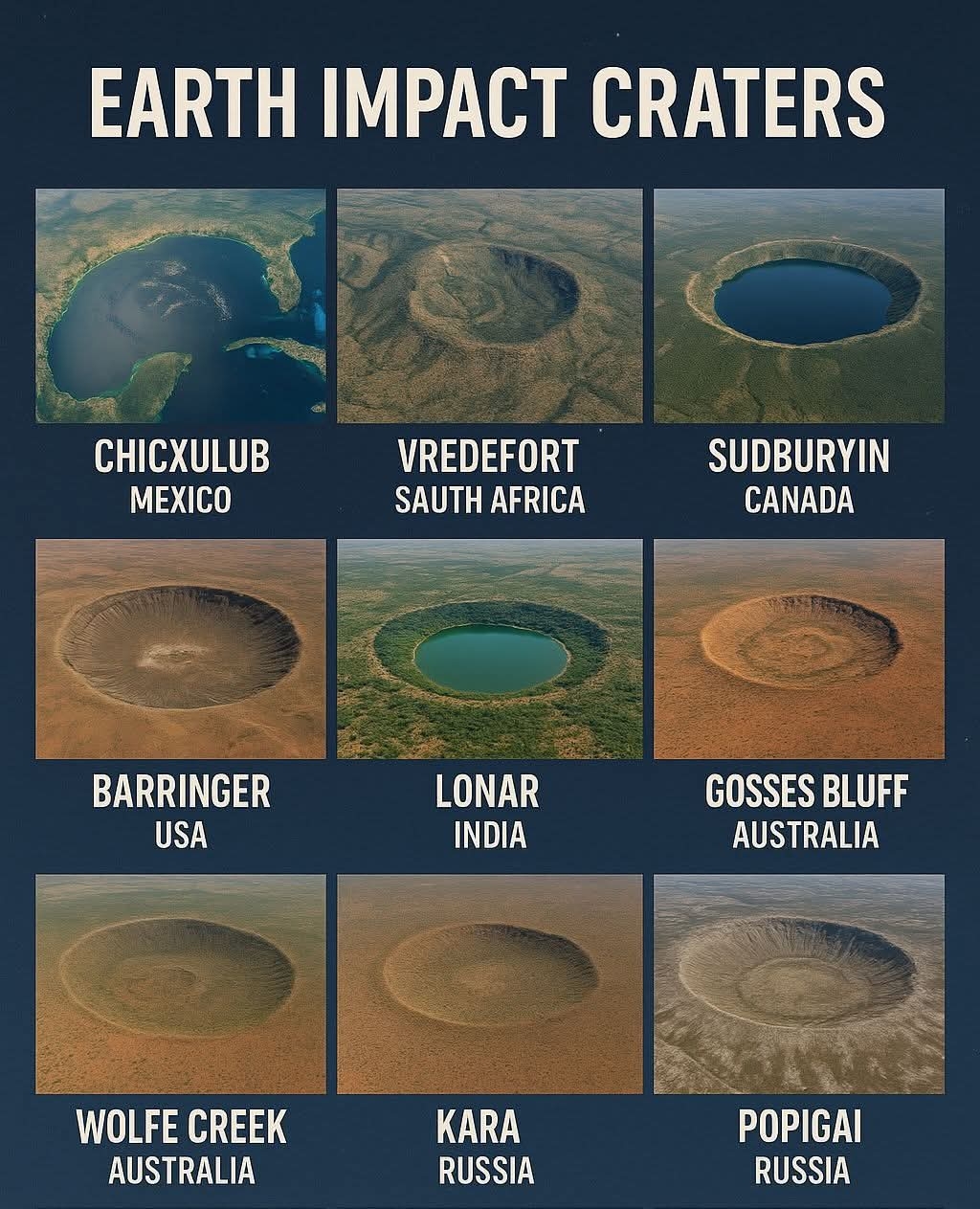
1. Chicxulub Crater (Mexico)
Fun Fact: This 180 km-wide crater is linked to the extinction of the dinosaurs 66 million years ago.
Cool Detail: It's buried beneath the Yucatán Peninsula, with only part visible in satellite imagery.
2. Vredefort Crater (South Africa)
Fun Fact: At 2 billion years old and about 300 km in diameter, it's the largest and oldest confirmed impact crater on Earth.
Cool Detail: The central uplift (Vredefort Dome) is now a UNESCO World Heritage Site.
3. Sudbury Basin (Canada)
Fun Fact: Formed 1.8 billion years ago, it’s the second-largest confirmed impact crater on Earth.
Cool Detail: Rich in nickel and other metals, it helped fuel Canada’s mining industry.
4. Manicouagan Crater (Canada)
Fun Fact: Known as the “Eye of Quebec,” this 100 km-wide crater has a distinctive ring lake.
Cool Detail: It’s easily visible from space and often mistaken for a volcanic caldera.
5. Barringer Crater (USA)
Fun Fact: Also called Meteor Crater, it's only about 50,000 years old and one of the best-preserved impact sites.
Cool Detail: The crater is just 1.2 km wide but was caused by a meteorite only 50 meters across.
6. Lonar Crater (India)
Fun Fact: This rare crater was formed in basaltic rock, making it geologically unique.
Cool Detail: It's filled with both saline and alkaline, supporting a rare dual ecosystem.
7. Gosses Bluff (Australia)
Fun Fact: Known as Tnorala to the Western Arrernte people, Aboriginal legend says it was formed by a baby falling from the Milky Way.
Cool Detail: The current visible ring is about 5 km across, but the original crater was closer to 22 km.
8. Wolfe Creek Crater (Australia)
Fun Fact: Featured in the horror movie Wolf Creek, it's one of the world’s best-preserved small impact craters.
Cool Detail: Aboriginal Dreamtime stories also describe the crater's formation in cosmic terms.
9. Kara Crater (Russia)
Fun Fact: It’s partly destroyed due to erosion and tectonic activity, but originally may have been up to 120 km wide.
Cool Detail: Located in the Russian Arctic, it's one of the most remote craters on the list.
10. Popigai Crater (Russia)
Fun Fact: This 100 km-wide crater is one of the largest diamond deposits in the world—caused by shock transformation of graphite.
Cool Detail: The diamonds are industrial-grade and not gem-quality, but incredibly abundant.
(Note:-Some craters are real, while others are AI-generated images .Some impact craters are hidden due to erosion, vegetation, urban development, or being underwater and their real picture are vanished.
In example :Vredefort (South Africa),Sudbury Crater...not real image)
The Aftermath of Impact: 10 Must-See Craters on Earth:
1. Chicxulub Crater (Mexico)
Fun Fact: This 180 km-wide crater is linked to the extinction of the dinosaurs 66 million years ago.
Cool Detail: It's buried beneath the Yucatán Peninsula, with only part visible in satellite imagery.
2. Vredefort Crater (South Africa)
Fun Fact: At 2 billion years old and about 300 km in diameter, it's the largest and oldest confirmed impact crater on Earth.
Cool Detail: The central uplift (Vredefort Dome) is now a UNESCO World Heritage Site.
3. Sudbury Basin (Canada)
Fun Fact: Formed 1.8 billion years ago, it’s the second-largest confirmed impact crater on Earth.
Cool Detail: Rich in nickel and other metals, it helped fuel Canada’s mining industry.
4. Manicouagan Crater (Canada)
Fun Fact: Known as the “Eye of Quebec,” this 100 km-wide crater has a distinctive ring lake.
Cool Detail: It’s easily visible from space and often mistaken for a volcanic caldera.
5. Barringer Crater (USA)
Fun Fact: Also called Meteor Crater, it's only about 50,000 years old and one of the best-preserved impact sites.
Cool Detail: The crater is just 1.2 km wide but was caused by a meteorite only 50 meters across.
6. Lonar Crater (India)
Fun Fact: This rare crater was formed in basaltic rock, making it geologically unique.
Cool Detail: It's filled with both saline and alkaline, supporting a rare dual ecosystem.
7. Gosses Bluff (Australia)
Fun Fact: Known as Tnorala to the Western Arrernte people, Aboriginal legend says it was formed by a baby falling from the Milky Way.
Cool Detail: The current visible ring is about 5 km across, but the original crater was closer to 22 km.
8. Wolfe Creek Crater (Australia)
Fun Fact: Featured in the horror movie Wolf Creek, it's one of the world’s best-preserved small impact craters.
Cool Detail: Aboriginal Dreamtime stories also describe the crater's formation in cosmic terms.
9. Kara Crater (Russia)
Fun Fact: It’s partly destroyed due to erosion and tectonic activity, but originally may have been up to 120 km wide.
Cool Detail: Located in the Russian Arctic, it's one of the most remote craters on the list.
10. Popigai Crater (Russia)
Fun Fact: This 100 km-wide crater is one of the largest diamond deposits in the world—caused by shock transformation of graphite.
Cool Detail: The diamonds are industrial-grade and not gem-quality, but incredibly abundant.
(Note:-Some craters are real, while others are AI-generated images .Some impact craters are hidden due to erosion, vegetation, urban development, or being underwater and their real picture are vanished.
In example :Vredefort (South Africa),Sudbury Crater...not real image)








 English
 Arabic
 French
 Spanish
 Portuguese
 Deutsch
 Dutch
Dutch
 Italiano
 Russian
 Romaian
 Portuguese (Brazil)
 Greek
Greek