If a yellowjacket nest turned up in the lawn this month, mark it with a flag, keep the mower and the dog away, and wait: the colony is at its biggest and meanest right now, but in most of the country it dies at the first hard freeze, the queens leave to winter under bark, and the nest is never used again. Fill the hole in November. The exterminator is for the nest by the back door or the one in the wall of the kids' room, not the one at the back of the lot.
October is the yellowjacket's month. The workers have switched from hunting insects to scavenging sugar, which is why they're in the soda can, on the cider doughnut and over the trash can lid. Cover drinks, pour the soda into a clear cup, keep the lid on the can, and don't swat; a crushed yellowjacket releases a scent that calls the others.
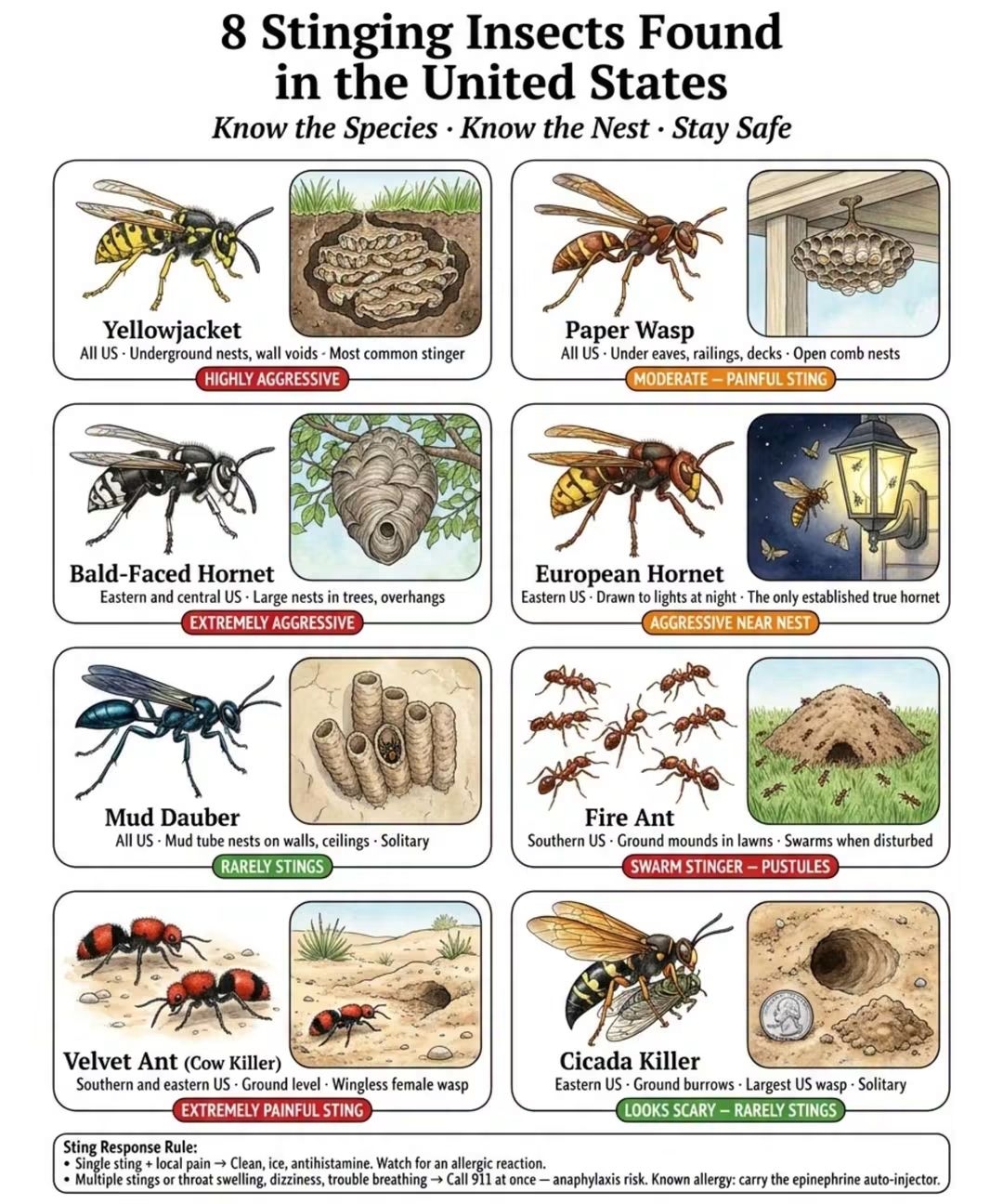
The rest of the card, in the order you'll meet them. Paper wasps on the porch rail are mellow unless the nest is grabbed; their combs are empty by November. The bald-faced hornet's gray paper ball shows up in the maple the week the leaves drop, and it's abandoned by then; leave it, or bag it on a freezing night. The European hornet, big and orange, is the one at the porch light after dark and chewing bark on the lilac in September; it's the only true hornet established here, since the northern giant hornet found in Washington in 2019 was declared eradicated in 2024. Mud daubers build the mud organ pipes under the eaves, stock them with spiders and almost never sting; leave them. Fire ants build fresh mounds after fall rains across the South, and this is the second window of the year for baiting them, on a warm afternoon when they're foraging. The velvet ant, red fuzz on black, is a wingless wasp with a sting that earns the name cow killer; it isn't aggressive, so the rule is don't pick it up. And the cicada killer, the two-inch wasp that dug the burrows in the lawn in July, is gone until next summer and barely stings anyway.
The sting rule. One sting with local pain: wash it, ice it, an over-the-counter antihistamine, and keep an eye on it. Several stings, or any swelling of the face or throat, dizziness or trouble breathing: call 911, because that's anaphylaxis, and anyone with a known allergy carries the epinephrine auto-injector from April to the first frost. Stings kill about 60 people a year in the US, nearly all from allergic reaction. This is general safety information, not medical advice.
Know the species, know the nest, and know that most of this list is harmless if you leave it alone
If a yellowjacket nest turned up in the lawn this month, mark it with a flag, keep the mower and the dog away, and wait: the colony is at its biggest and meanest right now, but in most of the country it dies at the first hard freeze, the queens leave to winter under bark, and the nest is never used again. Fill the hole in November. The exterminator is for the nest by the back door or the one in the wall of the kids' room, not the one at the back of the lot.
🍂 October is the yellowjacket's month. The workers have switched from hunting insects to scavenging sugar, which is why they're in the soda can, on the cider doughnut and over the trash can lid. Cover drinks, pour the soda into a clear cup, keep the lid on the can, and don't swat; a crushed yellowjacket releases a scent that calls the others.
The rest of the card, in the order you'll meet them. Paper wasps on the porch rail are mellow unless the nest is grabbed; their combs are empty by November. The bald-faced hornet's gray paper ball shows up in the maple the week the leaves drop, and it's abandoned by then; leave it, or bag it on a freezing night. The European hornet, big and orange, is the one at the porch light after dark and chewing bark on the lilac in September; it's the only true hornet established here, since the northern giant hornet found in Washington in 2019 was declared eradicated in 2024. Mud daubers build the mud organ pipes under the eaves, stock them with spiders and almost never sting; leave them. Fire ants build fresh mounds after fall rains across the South, and this is the second window of the year for baiting them, on a warm afternoon when they're foraging. The velvet ant, red fuzz on black, is a wingless wasp with a sting that earns the name cow killer; it isn't aggressive, so the rule is don't pick it up. And the cicada killer, the two-inch wasp that dug the burrows in the lawn in July, is gone until next summer and barely stings anyway.
🔦 The sting rule. One sting with local pain: wash it, ice it, an over-the-counter antihistamine, and keep an eye on it. Several stings, or any swelling of the face or throat, dizziness or trouble breathing: call 911, because that's anaphylaxis, and anyone with a known allergy carries the epinephrine auto-injector from April to the first frost. Stings kill about 60 people a year in the US, nearly all from allergic reaction. This is general safety information, not medical advice.
Know the species, know the nest, and know that most of this list is harmless if you leave it alone 🐝








 Arabic
 French
 Spanish
 Portuguese
 Deutsch
 Turkish
 Dutch
Dutch
 Italiano
 Russian
 Romaian
 Portuguese (Brazil)
 Greek
Greek