

• ChatGPT is no longer just a chatbot.

    It’s becoming an entire AI ecosystem for reasoning, research, creation, work, coding and automation.

    Here’s how the ecosystem fits together:

    01 — Models

    Different models can be used for different workloads.

    → GPT-5.6 Sol — complex reasoning
    → GPT-5.6 Terra — everyday intelligence
    → GPT-5.6 Luna — fast and efficient workloads

    02 — Chat & Reasoning

    ChatGPT can handle more than simple questions.

    → Deep reasoning
    → Multimodal input
    → Voice conversations
    → Files and images
    → Complex problem solving

    03 — Research & Creation

    Turn ideas into actual work.

    → Deep Research
    → ChatGPT Images
    → Documents
    → Spreadsheets
    → Presentations
    → Company knowledge
    → Website creation

    04 — Work & Agents

    This is where ChatGPT starts becoming an AI worker.

    → ChatGPT Work
    → Scheduled tasks
    → Monitoring
    → Long-running tasks
    → Connected tools
    → Codex for software development

    05 — Memory & Context

    ChatGPT can work with information beyond a single conversation.

    → Memory
    → Instructions
    → Personal context
    → Project context
    → Files
    → Projects

    06 — Apps & Automation

    Reusable workflows can turn repetitive work into automated processes.

    → Connections
    → External tools
    → Skills
    → Custom GPTs
    → Automation
    → Reusable workflows
    → Developer automation

    The bigger picture:

    ChatGPT → Reason → Research → Create → Work → Remember → Automate

    The future of AI isn’t just about asking better questions.

    It’s about building workflows where AI can understand context, use tools and complete real work.

    Save this visual for later.


    #ChatGPT #OpenAI #AI #ArtificialIntelligence #AIAgents #AItools #Automation #Productivity #GenerativeAI #AIEngineering
    ChatGPT is no longer just a chatbot. It’s becoming an entire AI ecosystem for reasoning, research, creation, work, coding and automation. Here’s how the ecosystem fits together: 01 — Models Different models can be used for different workloads. → GPT-5.6 Sol — complex reasoning → GPT-5.6 Terra — everyday intelligence → GPT-5.6 Luna — fast and efficient workloads 02 — Chat & Reasoning ChatGPT can handle more than simple questions. → Deep reasoning → Multimodal input → Voice conversations → Files and images → Complex problem solving 03 — Research & Creation Turn ideas into actual work. → Deep Research → ChatGPT Images → Documents → Spreadsheets → Presentations → Company knowledge → Website creation 04 — Work & Agents This is where ChatGPT starts becoming an AI worker. → ChatGPT Work → Scheduled tasks → Monitoring → Long-running tasks → Connected tools → Codex for software development 05 — Memory & Context ChatGPT can work with information beyond a single conversation. → Memory → Instructions → Personal context → Project context → Files → Projects 06 — Apps & Automation Reusable workflows can turn repetitive work into automated processes. → Connections → External tools → Skills → Custom GPTs → Automation → Reusable workflows → Developer automation The bigger picture: ChatGPT → Reason → Research → Create → Work → Remember → Automate The future of AI isn’t just about asking better questions. It’s about building workflows where AI can understand context, use tools and complete real work. Save this visual for later. #ChatGPT #OpenAI #AI #ArtificialIntelligence #AIAgents #AItools #Automation #Productivity #GenerativeAI #AIEngineering
    0 Comentários 0 Compartilhamentos 2K Visualizações
  • ChatGPT is no longer just a chatbot.

    It’s becoming an entire AI ecosystem for reasoning, research, creation, work, coding and automation.

    Here’s how the ecosystem fits together:

    01 — Models

    Different models can be used for different workloads.

    → GPT-5.6 Sol — complex reasoning
    → GPT-5.6 Terra — everyday intelligence
    → GPT-5.6 Luna — fast and efficient workloads

    02 — Chat & Reasoning

    ChatGPT can handle more than simple questions.

    → Deep reasoning
    → Multimodal input
    → Voice conversations
    → Files and images
    → Complex problem solving

    03 — Research & Creation

    Turn ideas into actual work.

    → Deep Research
    → ChatGPT Images
    → Documents
    → Spreadsheets
    → Presentations
    → Company knowledge
    → Website creation

    04 — Work & Agents

    This is where ChatGPT starts becoming an AI worker.

    → ChatGPT Work
    → Scheduled tasks
    → Monitoring
    → Long-running tasks
    → Connected tools
    → Codex for software development

    05 — Memory & Context

    ChatGPT can work with information beyond a single conversation.

    → Memory
    → Instructions
    → Personal context
    → Project context
    → Files
    → Projects

    06 — Apps & Automation

    Reusable workflows can turn repetitive work into automated processes.

    → Connections
    → External tools
    → Skills
    → Custom GPTs
    → Automation
    → Reusable workflows
    → Developer automation

    The bigger picture:

    ChatGPT → Reason → Research → Create → Work → Remember → Automate

    The future of AI isn’t just about asking better questions.

    It’s about building workflows where AI can understand context, use tools and complete real work.

    Save this visual for later.


    #ChatGPT #OpenAI #AI #ArtificialIntelligence #AIAgents #AItools #Automation #Productivity #GenerativeAI #AIEngineering
    ChatGPT is no longer just a chatbot. It’s becoming an entire AI ecosystem for reasoning, research, creation, work, coding and automation. Here’s how the ecosystem fits together: 01 — Models Different models can be used for different workloads. → GPT-5.6 Sol — complex reasoning → GPT-5.6 Terra — everyday intelligence → GPT-5.6 Luna — fast and efficient workloads 02 — Chat & Reasoning ChatGPT can handle more than simple questions. → Deep reasoning → Multimodal input → Voice conversations → Files and images → Complex problem solving 03 — Research & Creation Turn ideas into actual work. → Deep Research → ChatGPT Images → Documents → Spreadsheets → Presentations → Company knowledge → Website creation 04 — Work & Agents This is where ChatGPT starts becoming an AI worker. → ChatGPT Work → Scheduled tasks → Monitoring → Long-running tasks → Connected tools → Codex for software development 05 — Memory & Context ChatGPT can work with information beyond a single conversation. → Memory → Instructions → Personal context → Project context → Files → Projects 06 — Apps & Automation Reusable workflows can turn repetitive work into automated processes. → Connections → External tools → Skills → Custom GPTs → Automation → Reusable workflows → Developer automation The bigger picture: ChatGPT → Reason → Research → Create → Work → Remember → Automate The future of AI isn’t just about asking better questions. It’s about building workflows where AI can understand context, use tools and complete real work. Save this visual for later. #ChatGPT #OpenAI #AI #ArtificialIntelligence #AIAgents #AItools #Automation #Productivity #GenerativeAI #AIEngineering
    0 Comentários 0 Compartilhamentos 939 Visualizações 1
  • Why did highly trained US Combat Engineers intentionally violently spray raw, unlit gasoline directly at the enemy instead of lighting it on fire?
    Concrete pillboxes were incredibly tough, heavily armored fortresses.
    If an ordinary soldier fired a fully lit flamethrower directly at the front door, it was a fluid-dynamic failure! Fire is a rapidly expanding gas! When the roaring 2,000-degree flame hit the thick concrete, it violently expanded outward! It entirely bounced off the exterior wall, splashing harmlessly into the open sky! The enemy defenders sitting safely inside the concrete room barely felt the heat!
    Veteran US Combat Engineers deployed absolute psychological and chemical terror: The Cold Shot!
    They aggressively turned the igniter completely off! The incredibly brave engineer stepped right up to the bunker window! He pulled the trigger and violently blasted a massive, heavy stream of raw, completely unlit liquid Napalm directly into the room! The physics were utterly terrifying! Because the heavy liquid wasn't burning, it didn't expand! It flawlessly, seamlessly ricocheted off the walls, utterly flooding the entire enclosed space and completely physically soaking the terrified enemy defenders in incredibly sticky, highly volatile fuel! The engineer simply waited exactly three seconds, stepped back, and fired a single tiny spark! The entire fully-soaked room instantly, violently, and catastrophically erupted into a completely inescapable 2,000-degree internal vapor explosion, utterly neutralizing the bunker!
    Harmless bouncing flames or a genius utterly devastating liquid soaking?
    #SurvivalTactics #Strategy #WW2History #PhysicsFacts #USArmy #CombatEngineering #TacticalGear #Thermodynamics #MilitaryTech #CrossSection #EngineeringMarvel #HistoryGeek #WorldWar2 #UrbanWarfare #USMC #AmericanHistory #WW2USA #AmericanEngineering #USHistory #MilitaryHistoryUSA
    Why did highly trained US Combat Engineers intentionally violently spray raw, unlit gasoline directly at the enemy instead of lighting it on fire? 🔥🧱 Concrete pillboxes were incredibly tough, heavily armored fortresses. If an ordinary soldier fired a fully lit flamethrower directly at the front door, it was a fluid-dynamic failure! Fire is a rapidly expanding gas! When the roaring 2,000-degree flame hit the thick concrete, it violently expanded outward! It entirely bounced off the exterior wall, splashing harmlessly into the open sky! The enemy defenders sitting safely inside the concrete room barely felt the heat! Veteran US Combat Engineers deployed absolute psychological and chemical terror: The Cold Shot! They aggressively turned the igniter completely off! The incredibly brave engineer stepped right up to the bunker window! He pulled the trigger and violently blasted a massive, heavy stream of raw, completely unlit liquid Napalm directly into the room! The physics were utterly terrifying! Because the heavy liquid wasn't burning, it didn't expand! It flawlessly, seamlessly ricocheted off the walls, utterly flooding the entire enclosed space and completely physically soaking the terrified enemy defenders in incredibly sticky, highly volatile fuel! The engineer simply waited exactly three seconds, stepped back, and fired a single tiny spark! The entire fully-soaked room instantly, violently, and catastrophically erupted into a completely inescapable 2,000-degree internal vapor explosion, utterly neutralizing the bunker! Harmless bouncing flames or a genius utterly devastating liquid soaking? 👇 #SurvivalTactics #Strategy #WW2History #PhysicsFacts #USArmy #CombatEngineering #TacticalGear #Thermodynamics #MilitaryTech #CrossSection #EngineeringMarvel #HistoryGeek #WorldWar2 #UrbanWarfare #USMC #AmericanHistory #WW2USA #AmericanEngineering #USHistory #MilitaryHistoryUSA
    0 Comentários 0 Compartilhamentos 6K Visualizações
  • Automobile tires have undergone a remarkable transformation over the last century, evolving from simple rubber coverings into highly engineered components critical for safety, comfort, performance, and efficiency. This evolution reflects changes in vehicle design, road conditions, driving speeds, and advances in material science.

    In the early 1900s and 1920s, tires were narrow, tall, and often mounted on spoked wheels. These early tyres were made from natural rubber with cotton fabric plies and had smooth or lightly grooved surfaces. They were designed mainly to cope with rough, unpaved roads and low vehicle speeds. Durability was limited, punctures were common, and ride comfort was basic. Bias-ply construction dominated this era, where fabric layers were laid diagonally across each other, making tires stiff and prone to heat buildup.

    By the 1930s and 1940s, tire designs became slightly wider and stronger. Rubber compounds improved, and tread patterns became more defined to enhance grip on wet and muddy roads. During this period, vehicles grew heavier and faster, especially due to wartime engineering advances, pushing tire manufacturers to focus more on load capacity and reliability.

    The 1950s marked a major visual and technical shift with the introduction of whitewall tyres, symbolizing style and luxury. More importantly, tire construction continued to improve, offering better comfort and longer life. In the late 1940s and 1950s, radial tire technology was developed, though it gained widespread adoption slightly later. Radial tires used steel belts laid perpendicular to the direction of travel, significantly improving grip, fuel efficiency, and tread life.

    During the 1960s and 1970s, radial tires became mainstream globally. Tires grew wider, and tread designs became more aggressive to support higher speeds and better cornering. Performance-oriented tires emerged alongside off-road and all-terrain tires, reflecting the rise of sports cars and utility vehicles. Safety, heat resistance, and handling became central design goals.

    By the 1980s and 1990s, tire technology advanced rapidly. Low-profile tyres paired with alloy wheels became popular, improving handling and aesthetics. Rubber compounds were enhanced using synthetic materials, silica, and carbon black to balance grip, durability, and rolling resistance. Specialized tires such as winter tires, high-performance summer tires, and touring tires became common, each designed for specific driving conditions.

    From the 2000s onward, tires evolved into highly specialized, technology-driven products. Modern tires feature advanced tread patterns for noise reduction, water dispersion, and improved braking. Run-flat tires allow limited driving even after punctures, while tubeless designs became standard for safety and convenience. Sensors for tire pressure monitoring systems (TPMS) were integrated to enhance safety.

    Today, tires are engineered with sustainability and efficiency in mind. There are eco-friendly tires designed to reduce rolling resistance and improve electric vehicle range, ultra-high-performance tires for sports cars, all-season tires for everyday use, off-road and mud-terrain tires for extreme conditions, and smart tires being developed with embedded sensors to monitor wear, temperature, and road conditions in real time.

    From simple rubber rings to intelligent, high-performance components, tire evolution mirrors the progress of the automobile itself focused on safety, efficiency, comfort, and innovation.

    #TireEvolution #AutomobileHistory #CarTechnology #RadialTires #VehicleSafety #AutomotiveEngineering #ModernTires #MobilityInnovation #Cars #Tire
    Automobile tires have undergone a remarkable transformation over the last century, evolving from simple rubber coverings into highly engineered components critical for safety, comfort, performance, and efficiency. This evolution reflects changes in vehicle design, road conditions, driving speeds, and advances in material science. In the early 1900s and 1920s, tires were narrow, tall, and often mounted on spoked wheels. These early tyres were made from natural rubber with cotton fabric plies and had smooth or lightly grooved surfaces. They were designed mainly to cope with rough, unpaved roads and low vehicle speeds. Durability was limited, punctures were common, and ride comfort was basic. Bias-ply construction dominated this era, where fabric layers were laid diagonally across each other, making tires stiff and prone to heat buildup. By the 1930s and 1940s, tire designs became slightly wider and stronger. Rubber compounds improved, and tread patterns became more defined to enhance grip on wet and muddy roads. During this period, vehicles grew heavier and faster, especially due to wartime engineering advances, pushing tire manufacturers to focus more on load capacity and reliability. The 1950s marked a major visual and technical shift with the introduction of whitewall tyres, symbolizing style and luxury. More importantly, tire construction continued to improve, offering better comfort and longer life. In the late 1940s and 1950s, radial tire technology was developed, though it gained widespread adoption slightly later. Radial tires used steel belts laid perpendicular to the direction of travel, significantly improving grip, fuel efficiency, and tread life. During the 1960s and 1970s, radial tires became mainstream globally. Tires grew wider, and tread designs became more aggressive to support higher speeds and better cornering. Performance-oriented tires emerged alongside off-road and all-terrain tires, reflecting the rise of sports cars and utility vehicles. Safety, heat resistance, and handling became central design goals. By the 1980s and 1990s, tire technology advanced rapidly. Low-profile tyres paired with alloy wheels became popular, improving handling and aesthetics. Rubber compounds were enhanced using synthetic materials, silica, and carbon black to balance grip, durability, and rolling resistance. Specialized tires such as winter tires, high-performance summer tires, and touring tires became common, each designed for specific driving conditions. From the 2000s onward, tires evolved into highly specialized, technology-driven products. Modern tires feature advanced tread patterns for noise reduction, water dispersion, and improved braking. Run-flat tires allow limited driving even after punctures, while tubeless designs became standard for safety and convenience. Sensors for tire pressure monitoring systems (TPMS) were integrated to enhance safety. Today, tires are engineered with sustainability and efficiency in mind. There are eco-friendly tires designed to reduce rolling resistance and improve electric vehicle range, ultra-high-performance tires for sports cars, all-season tires for everyday use, off-road and mud-terrain tires for extreme conditions, and smart tires being developed with embedded sensors to monitor wear, temperature, and road conditions in real time. From simple rubber rings to intelligent, high-performance components, tire evolution mirrors the progress of the automobile itself focused on safety, efficiency, comfort, and innovation. #TireEvolution #AutomobileHistory #CarTechnology #RadialTires #VehicleSafety #AutomotiveEngineering #ModernTires #MobilityInnovation #Cars #Tire
    0 Comentários 0 Compartilhamentos 16K Visualizações
  • Historical and Educational Comparison Only: 9×19mm Parabellum vs 9×18mm Makarov Handguns – Strictly Informational and Academic Post

    This infographic is shared exclusively for historical, educational, and academic purposes: providing a neutral, factual side-by-side overview of select semi-automatic handguns chambered in 9×19mm Parabellum and 9×18mm Makarov, including origins, introduction years, and design features.

    It focuses solely on cartridge and engineering differences—no contemporary implications, endorsements, or modern relevance intended.
    Historical and Educational Comparison Only: 9×19mm Parabellum vs 9×18mm Makarov Handguns – Strictly Informational and Academic Post This infographic is shared exclusively for historical, educational, and academic purposes: providing a neutral, factual side-by-side overview of select semi-automatic handguns chambered in 9×19mm Parabellum and 9×18mm Makarov, including origins, introduction years, and design features. It focuses solely on cartridge and engineering differences—no contemporary implications, endorsements, or modern relevance intended.
    0 Comentários 0 Compartilhamentos 3K Visualizações
  • These houses are in Norway, covered in moss, the heat never leaves, the cold only because it doesn't enter. This engineering was carried out by the ancient Viking inhabitants
    These houses are in Norway, covered in moss, the heat never leaves, the cold only because it doesn't enter. This engineering was carried out by the ancient Viking inhabitants
    0 Comentários 0 Compartilhamentos 2K Visualizações
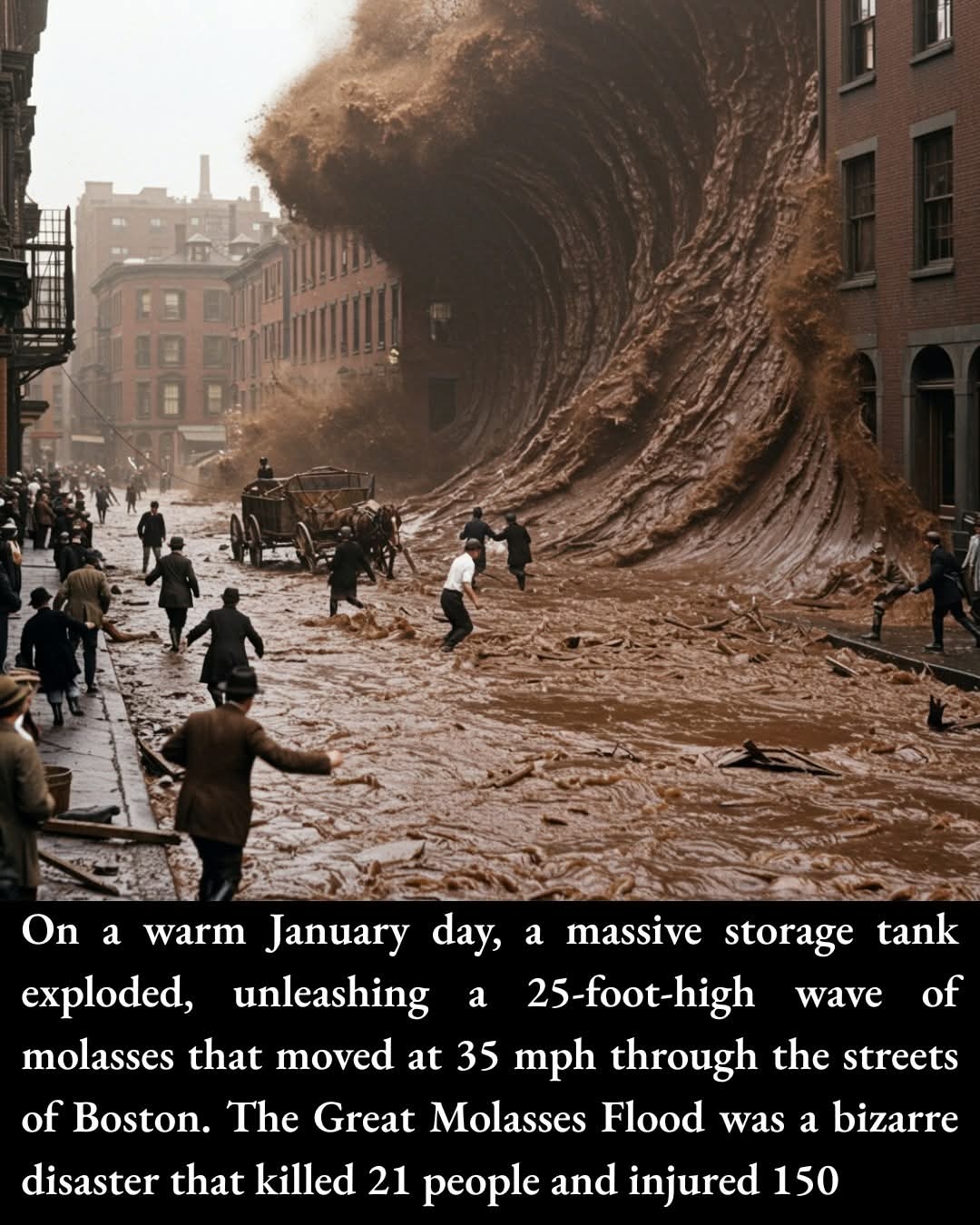
  • It is one of the strangest disasters in American history. On January 15, 1919, in the North End of Boston, a massive, 50-foot-tall steel storage tank suddenly ruptured. The tank contained over 2.3 million gallons of molasses, which was used to produce industrial alcohol for munitions. The rupture unleashed a colossal wave of sticky, brown molasses, estimated to be 25 feet high at its peak, which crashed through the streets at a speed of 35 miles per hour. The force of the wave was incredible. It was so powerful it knocked buildings off their foundations, buckled the elevated railway tracks, and swept up everything in its path. People and animals caught in the wave were either crushed by the force or suffocated in the thick, viscous liquid. In total, 21 people were killed, and 150 were injured. The cleanup took weeks, and the harbor was stained brown for months. For decades after, residents claimed that on hot summer days, the sweet smell of molasses still lingered in the neighborhood. The disaster was later found to have been caused by a poorly constructed and tested tank, leading to one of the first class-action lawsuits in Massachusetts history and new standards for engineering and construction.
    It is one of the strangest disasters in American history. On January 15, 1919, in the North End of Boston, a massive, 50-foot-tall steel storage tank suddenly ruptured. The tank contained over 2.3 million gallons of molasses, which was used to produce industrial alcohol for munitions. The rupture unleashed a colossal wave of sticky, brown molasses, estimated to be 25 feet high at its peak, which crashed through the streets at a speed of 35 miles per hour. The force of the wave was incredible. It was so powerful it knocked buildings off their foundations, buckled the elevated railway tracks, and swept up everything in its path. People and animals caught in the wave were either crushed by the force or suffocated in the thick, viscous liquid. In total, 21 people were killed, and 150 were injured. The cleanup took weeks, and the harbor was stained brown for months. For decades after, residents claimed that on hot summer days, the sweet smell of molasses still lingered in the neighborhood. The disaster was later found to have been caused by a poorly constructed and tested tank, leading to one of the first class-action lawsuits in Massachusetts history and new standards for engineering and construction.
    0 Comentários 0 Compartilhamentos 4K Visualizações
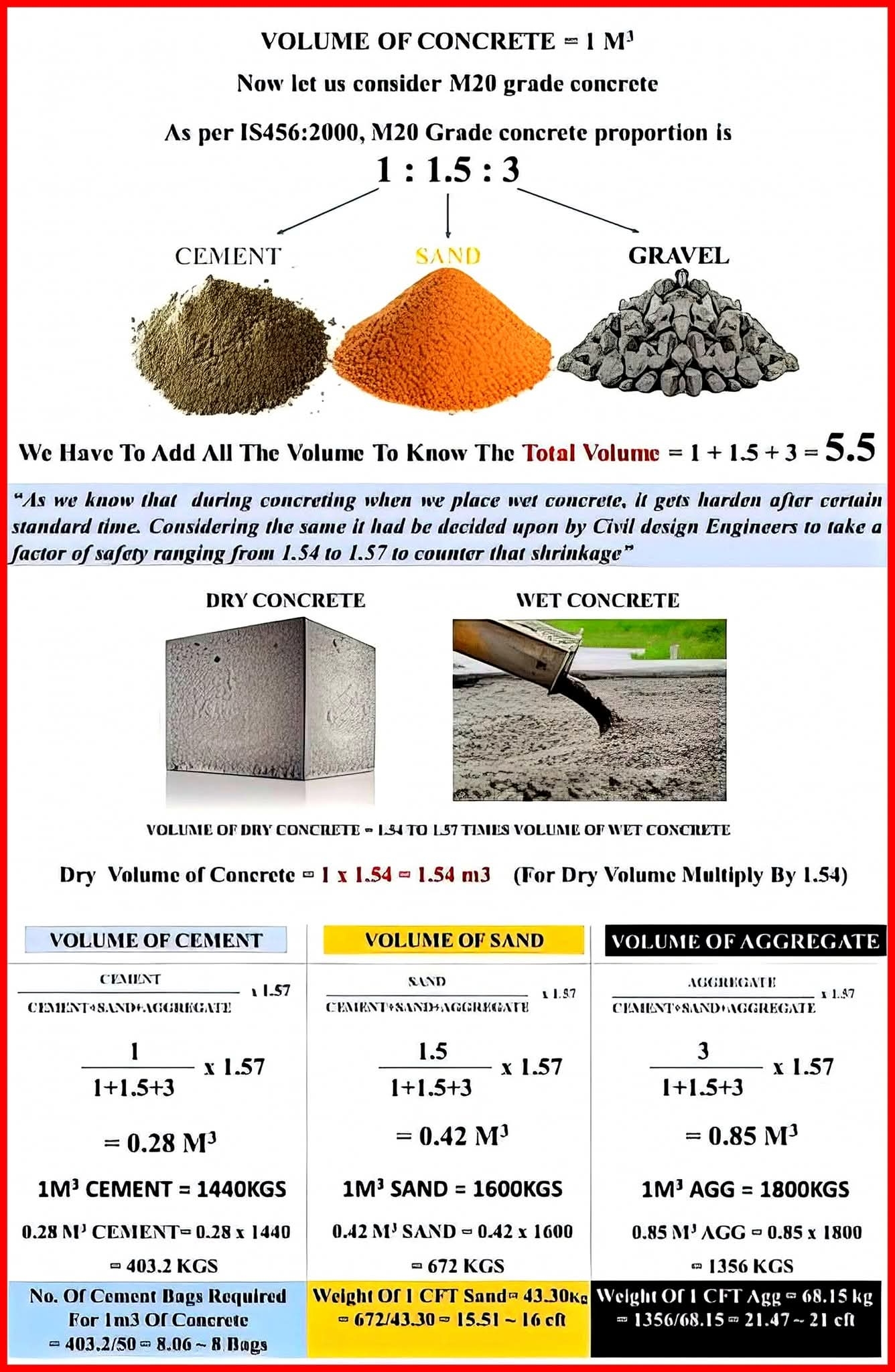
  • This infographic explains how to calculate the exact amounts of cement, sand, and gravel needed for M20 grade concrete.

    The process starts with the standard M20 mix proportion of 1:1.5:3 (1 part cement, 1.5 parts sand, and 3 parts gravel). A crucial step often overlooked is accounting for the shrinkage that occurs when wet concrete hardens. To compensate for this volume loss, civil engineers apply a safety factor (typically 1.54 to 1.57) to the desired wet volume to determine the required dry volume of materials.

    Following the calculations in the image to get 1 cubic meter of finished concrete, you would need:

    Cement: 0.28 m³, or approximately 8 bags.

    Sand: 0.42 m³, or about 16 cubic feet.

    Aggregate (Gravel): 0.85 m³, or about 21 cubic feet.

    This is a fantastic reference for getting your mix proportions right every time!

    #CivilEngineering #Construction #ConcreteMix #BuildingTips #DIYProjects #Engineering #M20Concrete #ConstructionMath #BuildingMaterials
    This infographic explains how to calculate the exact amounts of cement, sand, and gravel needed for M20 grade concrete. The process starts with the standard M20 mix proportion of 1:1.5:3 (1 part cement, 1.5 parts sand, and 3 parts gravel). A crucial step often overlooked is accounting for the shrinkage that occurs when wet concrete hardens. To compensate for this volume loss, civil engineers apply a safety factor (typically 1.54 to 1.57) to the desired wet volume to determine the required dry volume of materials. Following the calculations in the image to get 1 cubic meter of finished concrete, you would need: Cement: 0.28 m³, or approximately 8 bags. Sand: 0.42 m³, or about 16 cubic feet. Aggregate (Gravel): 0.85 m³, or about 21 cubic feet. This is a fantastic reference for getting your mix proportions right every time! #CivilEngineering #Construction #ConcreteMix #BuildingTips #DIYProjects #Engineering #M20Concrete #ConstructionMath #BuildingMaterials
    0 Comentários 0 Compartilhamentos 10K Visualizações
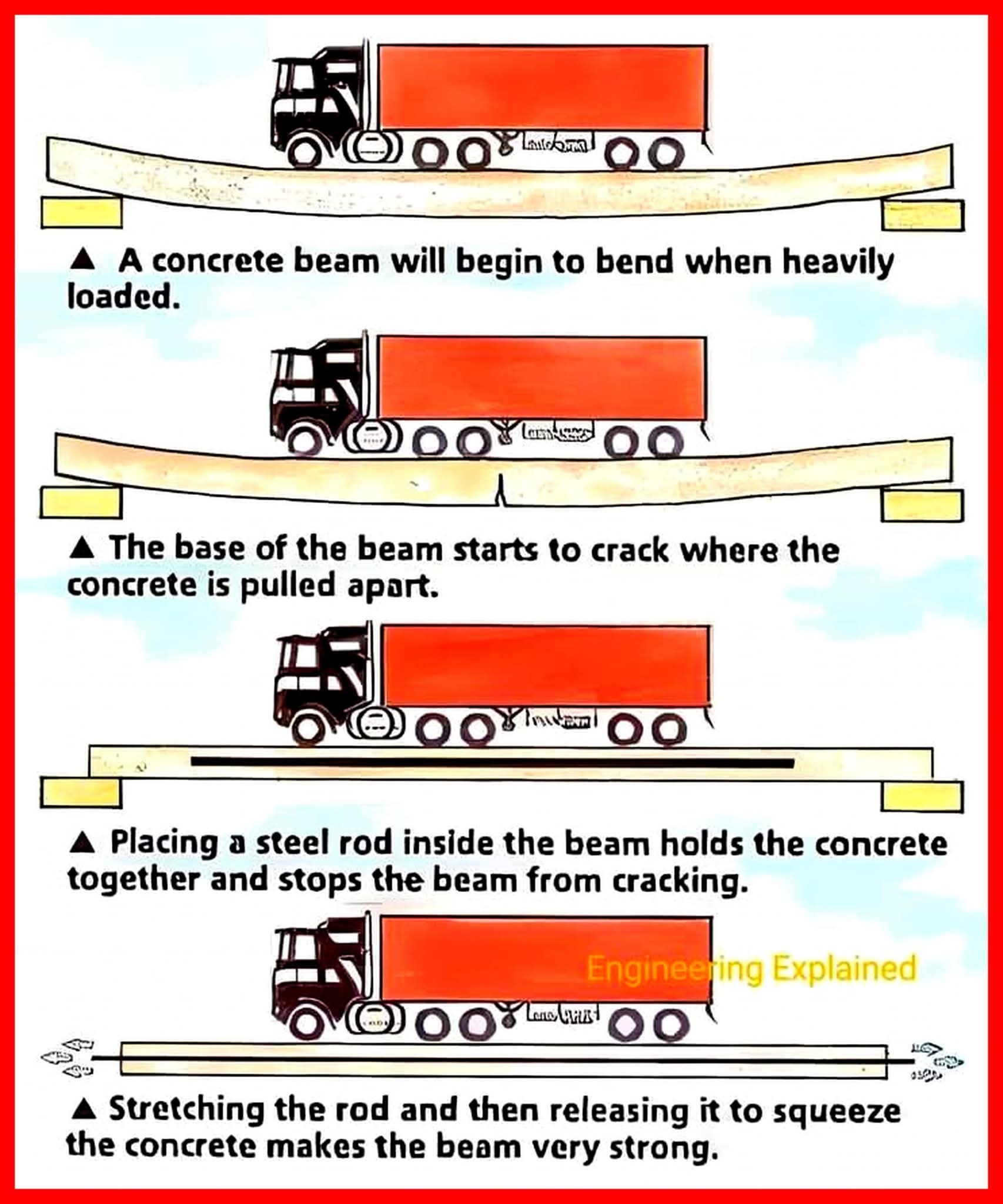
  • Step-by-step explanation of how reinforced and prestressed concrete beams work under heavy loads. Concrete alone is strong in compression but weak in tension, which is why reinforcement is crucial for structural safety and durability.

    1️⃣ Concrete Beam Under Load: A plain concrete beam bends when a heavy load (like a truck) is applied, showing its natural weakness under tension.
    2️⃣ Cracking at the Base: The base of the beam begins to crack because concrete is being pulled apart due to tensile stress.
    3️⃣ Reinforced with Steel Rods: By placing a steel rod inside the beam, the reinforcement holds the concrete together, preventing cracks and providing tensile strength.
    4️⃣ Prestressed Concrete: When the steel rod is stretched before pouring concrete and then released, it compresses the beam. This pre-compression counters the tensile forces when loads are applied, making the beam significantly stronger and more durable.

    This is why modern construction uses reinforced and prestressed concrete beams in bridges, buildings, and highways, ensuring safety and longevity under massive loads.

    #EngineeringExplained #CivilEngineering #ConcreteStructures #StructuralEngineering #ReinforcedConcrete #PrestressedConcrete #ConstructionTech
    Step-by-step explanation of how reinforced and prestressed concrete beams work under heavy loads. Concrete alone is strong in compression but weak in tension, which is why reinforcement is crucial for structural safety and durability. 1️⃣ Concrete Beam Under Load: A plain concrete beam bends when a heavy load (like a truck) is applied, showing its natural weakness under tension. 2️⃣ Cracking at the Base: The base of the beam begins to crack because concrete is being pulled apart due to tensile stress. 3️⃣ Reinforced with Steel Rods: By placing a steel rod inside the beam, the reinforcement holds the concrete together, preventing cracks and providing tensile strength. 4️⃣ Prestressed Concrete: When the steel rod is stretched before pouring concrete and then released, it compresses the beam. This pre-compression counters the tensile forces when loads are applied, making the beam significantly stronger and more durable. 👉 This is why modern construction uses reinforced and prestressed concrete beams in bridges, buildings, and highways, ensuring safety and longevity under massive loads. 🚛🏗️ #EngineeringExplained #CivilEngineering #ConcreteStructures #StructuralEngineering #ReinforcedConcrete #PrestressedConcrete #ConstructionTech
    0 Comentários 0 Compartilhamentos 11K Visualizações
Páginas Impulsionadas