


• This engraving depicts a scene from the Haitian Revolution (1791–1804), specifically titled "Revenge taken by the Black Army for the cruelties practiced on them by the French".

    The image portrays members of the Black Army—a force of formerly enslaved people and free people of color—executing French officers by hanging.

    The revolution was characterized by extreme violence on both sides.

    This particular scene was a direct response to the atrocities committed by French forces under General Charles Leclerc and General Rochambeau, who attempted to restore slavery and French control over the colony then known as Saint-Domingue.

    The artwork was created by Marcus Rainsford and published in 1805 in his book, An Historical Account of the Black Empire of Hayti.
    Rainsford, a former British captain, documented the revolution's events and provided some of the earliest visual records of the conflict.

    The image symbolizes the shift in power during the later stages of the revolution when the Black Army, led by figures like Jean-Jacques Dessalines, successfully repelled Napoleon Bonaparte's massive expeditionary force.

    The revolution began in August 1791 as a mass uprising of enslaved people inspired by the ideals of the French Revolution.

    It is widely regarded as the most successful slave rebellion in history, resulting in the permanent abolition of slavery and the establishment of Haiti as the world's first independent Black-led republic in 1804.
    This engraving depicts a scene from the Haitian Revolution (1791–1804), specifically titled "Revenge taken by the Black Army for the cruelties practiced on them by the French". The image portrays members of the Black Army—a force of formerly enslaved people and free people of color—executing French officers by hanging. The revolution was characterized by extreme violence on both sides. This particular scene was a direct response to the atrocities committed by French forces under General Charles Leclerc and General Rochambeau, who attempted to restore slavery and French control over the colony then known as Saint-Domingue. The artwork was created by Marcus Rainsford and published in 1805 in his book, An Historical Account of the Black Empire of Hayti. Rainsford, a former British captain, documented the revolution's events and provided some of the earliest visual records of the conflict. The image symbolizes the shift in power during the later stages of the revolution when the Black Army, led by figures like Jean-Jacques Dessalines, successfully repelled Napoleon Bonaparte's massive expeditionary force. The revolution began in August 1791 as a mass uprising of enslaved people inspired by the ideals of the French Revolution. It is widely regarded as the most successful slave rebellion in history, resulting in the permanent abolition of slavery and the establishment of Haiti as the world's first independent Black-led republic in 1804.
    0 Kommentare 0 Anteile 2537 Ansichten
  • Few people know that Brazil has the largest population of black people outside of the African continent. In fact, it is the second largest “Black nation” after Nigeria, with over 100 million Black people.

    Yet, there is little information in the media outside of the country about this group, specifically, information about the history of Africans in the country that defined and continues to define the affairs of black people globally. For example, the country’s Malê Revolt in its province of Bahia in 1835 is not only considered the most important revolt in Brazillian history but it is believed to have been instrumental in bringing an end to the international slave trade in the country.

    Historians say that on the night of January 24 to 25, 1835, African-born slaves and freed-people in the northeastern Brazilian city of Salvador da Bahia carried out a rebellion to liberate themselves from slavery and create an Islamic homeland. The group of some six hundred Yoruba, Nupe, Kanuri and Hausa people from present-day Nigeria were led by Muslim leaders, having heard of and being inspired by the Haitian Revolution (1791−1804).

    SOURCE: Face2FaceAfrica

    https://face2faceafrica.com/article/how-enslaved-nigerians-in-brazil-helped-usher-in-the-end-of-international-slave-trade-in-1835

    #Brazil #Nigeria #African #AfricanHistory #Yoruba #Hausa #Slavery #Haiti #HaitiRevolution
    Few people know that Brazil has the largest population of black people outside of the African continent. In fact, it is the second largest “Black nation” after Nigeria, with over 100 million Black people. Yet, there is little information in the media outside of the country about this group, specifically, information about the history of Africans in the country that defined and continues to define the affairs of black people globally. For example, the country’s Malê Revolt in its province of Bahia in 1835 is not only considered the most important revolt in Brazillian history but it is believed to have been instrumental in bringing an end to the international slave trade in the country. Historians say that on the night of January 24 to 25, 1835, African-born slaves and freed-people in the northeastern Brazilian city of Salvador da Bahia carried out a rebellion to liberate themselves from slavery and create an Islamic homeland. The group of some six hundred Yoruba, Nupe, Kanuri and Hausa people from present-day Nigeria were led by Muslim leaders, having heard of and being inspired by the Haitian Revolution (1791−1804). SOURCE: Face2FaceAfrica https://face2faceafrica.com/article/how-enslaved-nigerians-in-brazil-helped-usher-in-the-end-of-international-slave-trade-in-1835 #Brazil #Nigeria #African #AfricanHistory #Yoruba #Hausa #Slavery #Haiti #HaitiRevolution
    0 Kommentare 0 Anteile 5845 Ansichten
  • Barbie and Hot Wheels, two of the most famous toys, were created by husband and wife Ruth and Elliot Handler, who co-founded Mattel. Ruth introduced Barbie in 1959, inspired by her daughter's imaginative play. Elliot launched Hot Wheels in 1968, designing fast, colorful toy cars.
    Barbie and Hot Wheels, two of the most famous toys, were created by husband and wife Ruth and Elliot Handler, who co-founded Mattel. Ruth introduced Barbie in 1959, inspired by her daughter's imaginative play. Elliot launched Hot Wheels in 1968, designing fast, colorful toy cars. 🚗
    0 Kommentare 0 Anteile 1064 Ansichten
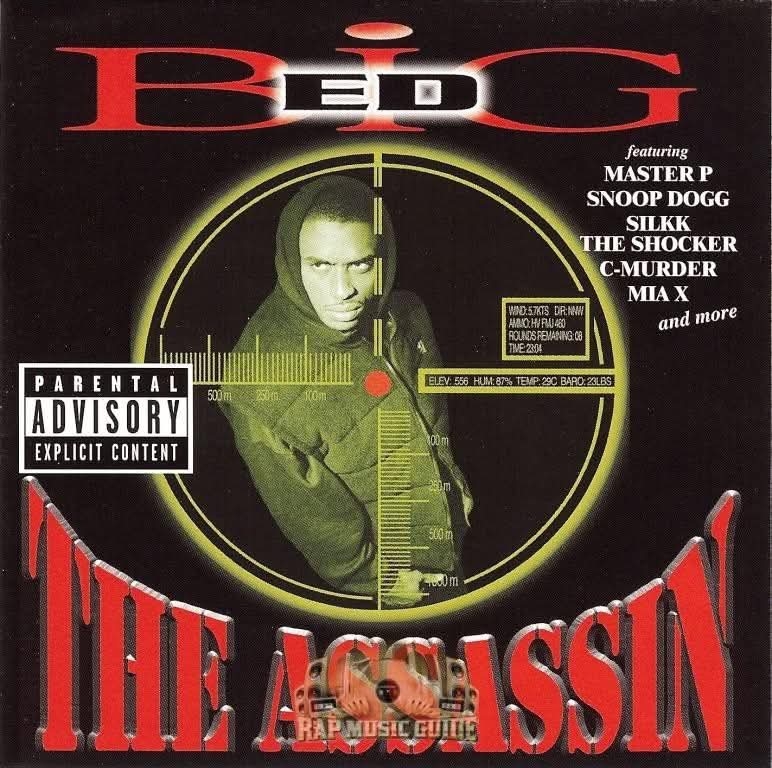
  • Big Ed – The Assassin

    On September 1, 1998, No Limit soldier Big Ed released his debut album The Assassin under Master P’s legendary No Limit Records.

    Part of the golden era of the tank, the album featured appearances from Master P, Snoop Dogg, Silkk the Shocker, C-Murder, Mia X, and more — showcasing the full No Limit roster’s strength at the time. With its gritty Southern beats, military-inspired production, and raw street energy, The Assassin stood as one of the many projects that kept No Limit dominating the late ’90s charts.

    While Big Ed didn’t achieve the mainstream fame of some of his labelmates, The Assassin remains a true piece of No Limit history, reflecting the label’s relentless output and influence.
    Big Ed – The Assassin On September 1, 1998, No Limit soldier Big Ed released his debut album The Assassin under Master P’s legendary No Limit Records. Part of the golden era of the tank, the album featured appearances from Master P, Snoop Dogg, Silkk the Shocker, C-Murder, Mia X, and more — showcasing the full No Limit roster’s strength at the time. With its gritty Southern beats, military-inspired production, and raw street energy, The Assassin stood as one of the many projects that kept No Limit dominating the late ’90s charts. 💿 While Big Ed didn’t achieve the mainstream fame of some of his labelmates, The Assassin remains a true piece of No Limit history, reflecting the label’s relentless output and influence.
    0 Kommentare 0 Anteile 3460 Ansichten
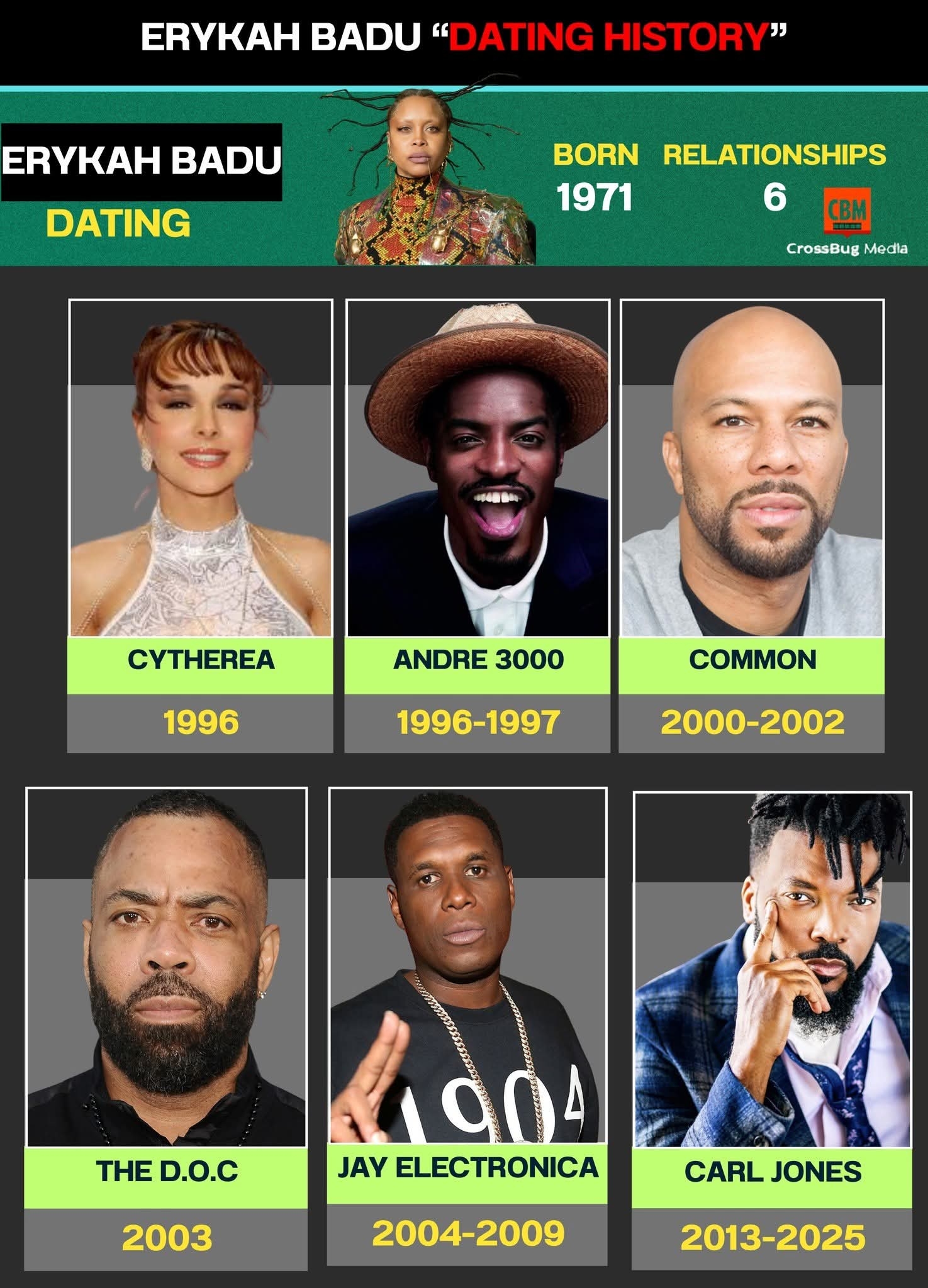
  • ERYKAH BADU’S DATING HISTORY: MYSTICAL LOVE, MUSIC LEGENDS & SOUL CONNECTIONS

    Soulful, mystical, and unapologetically unique—Erykah Badu has long been a force of nature in the music industry. Known for her enchanting voice, bohemian aesthetic, and deeply spiritual presence, Badu’s romantic life has been just as captivating. Over the years, she’s been linked to hip-hop royalty, conscious creatives, and cultural visionaries. Often a muse and a partner, Erykah’s dating history reflects her love for depth, energy, and authenticity. Here's a closer look at her beautiful and complex romantic timeline.

    Cytherea – 1996
    In a little-known connection, Badu was briefly linked to Cytherea in 1996. Although this relationship remains shrouded in mystery, it marked the beginning of a public intrigue surrounding her love life.

    André 3000 – 1996 to 1997
    Perhaps her most iconic romance, Erykah and André 3000 of Outkast formed one of hip-hop’s most beloved power couples. Their relationship inspired several songs, including André’s “Ms. Jackson,” and together they share a son, Seven Sirius Benjamin. Their connection was deeply artistic and spiritual.

    Common – 2000 to 2002
    The soulful rapper Common dated Badu during the early 2000s, creating a relationship that blended intellectualism, activism, and artistry. Though brief, their time together was influential, with both artists citing mutual growth through their bond.

    The D.O.C – 2003
    In 2003, Badu had a relationship with legendary rapper and songwriter The D.O.C. They share a daughter together, Puma Sabti Curry, and maintained a strong co-parenting relationship after their split.

    Jay Electronica – 2004 to 2009
    Her relationship with the elusive and mystical rapper Jay Electronica lasted five years and resulted in the birth of her youngest daughter, Mars Merkaba Thedford. Their union was deeply spiritual and reflected their shared philosophical values.

    Carl Jones – 2013 to 2025
    Since 2013, Erykah has been romantically linked to Carl Jones, a producer and writer best known for The Boondocks and Black Dynamite. Their relationship is private, but their connection runs deep, rooted in creativity, humor, and mutual respect.

    From cosmic connections to musical muses, Erykah Badu’s romantic journey mirrors her artistry: authentic, transcendent, and deeply human. Her dating history reads like a lyrical poem—each love a stanza in her timeless song.

    #ErykahBadu #DatingHistory #NeoSoulQueen #André3000 #Common #JayElectronica #CarlJones #BohemianLove
    🌟🎤 ERYKAH BADU’S DATING HISTORY: MYSTICAL LOVE, MUSIC LEGENDS & SOUL CONNECTIONS Soulful, mystical, and unapologetically unique—Erykah Badu has long been a force of nature in the music industry. Known for her enchanting voice, bohemian aesthetic, and deeply spiritual presence, Badu’s romantic life has been just as captivating. Over the years, she’s been linked to hip-hop royalty, conscious creatives, and cultural visionaries. Often a muse and a partner, Erykah’s dating history reflects her love for depth, energy, and authenticity. Here's a closer look at her beautiful and complex romantic timeline. 🎥 Cytherea – 1996 In a little-known connection, Badu was briefly linked to Cytherea in 1996. Although this relationship remains shrouded in mystery, it marked the beginning of a public intrigue surrounding her love life. 🎤 André 3000 – 1996 to 1997 Perhaps her most iconic romance, Erykah and André 3000 of Outkast formed one of hip-hop’s most beloved power couples. Their relationship inspired several songs, including André’s “Ms. Jackson,” and together they share a son, Seven Sirius Benjamin. Their connection was deeply artistic and spiritual. 🧠 Common – 2000 to 2002 The soulful rapper Common dated Badu during the early 2000s, creating a relationship that blended intellectualism, activism, and artistry. Though brief, their time together was influential, with both artists citing mutual growth through their bond. 🎙️ The D.O.C – 2003 In 2003, Badu had a relationship with legendary rapper and songwriter The D.O.C. They share a daughter together, Puma Sabti Curry, and maintained a strong co-parenting relationship after their split. ⚡ Jay Electronica – 2004 to 2009 Her relationship with the elusive and mystical rapper Jay Electronica lasted five years and resulted in the birth of her youngest daughter, Mars Merkaba Thedford. Their union was deeply spiritual and reflected their shared philosophical values. 🎨 Carl Jones – 2013 to 2025 Since 2013, Erykah has been romantically linked to Carl Jones, a producer and writer best known for The Boondocks and Black Dynamite. Their relationship is private, but their connection runs deep, rooted in creativity, humor, and mutual respect. 💫 From cosmic connections to musical muses, Erykah Badu’s romantic journey mirrors her artistry: authentic, transcendent, and deeply human. Her dating history reads like a lyrical poem—each love a stanza in her timeless song. #ErykahBadu #DatingHistory #NeoSoulQueen #André3000 #Common #JayElectronica #CarlJones #BohemianLove
    0 Kommentare 0 Anteile 14826 Ansichten
  • In 1993, Crucial Conflict was still years away from their breakout hit “Hay,” but they were already making serious noise on the underground Chicago circuit. What most fans don’t know is that their first recordings were done on cassette through a tiny West Side basement studio run by producer Wildstyle, who later became the group’s in-house beatmaker. According to a 1996 interview in Rap Sheet, the group was developing a fast-paced, harmonized style inspired by Bone Thugs-N-Harmony, but with deeper roots in Chicago’s juke, footwork, and blues scenes. The original lineup was even slightly different, with some early sessions rumored to include verses from local artists who didn’t make the final cut when they signed with Universal.

    A rarely confirmed rumor, supported by DJ Geno from Chicago’s old WGCI radio staff, says that Crucial Conflict recorded an unreleased EP in 1993 titled Mad Conflict, featuring early versions of “Desperado” and “Ride the Rodeo” before they were polished for The Final Tic. These early demos were passed around on dubbed tapes in high schools across the West Side and South Side and even made it into the hands of Twista, who gave the group props publicly at a 1994 open mic at the Cotton Club. Some of these tapes reportedly still exist in collector circles, making them one of the most valuable lost gems in Chicago hip hop history.

    Sources:
    Rap Sheet Magazine (1996 Crucial Conflict interview)
    DJ Geno interview on Vocalo Radio (2018)
    WGCI Radio Archives (1993 playlist reports)
    The Final Tic Liner Notes (1996, Universal Records)
    Chicago Hip Hop Oral History Project (University of Chicago, 2005)

    #CrucialConflict #Chicago #HipHop #1993Rap #WestSideChicago
    ✅ In 1993, Crucial Conflict was still years away from their breakout hit “Hay,” but they were already making serious noise on the underground Chicago circuit. What most fans don’t know is that their first recordings were done on cassette through a tiny West Side basement studio run by producer Wildstyle, who later became the group’s in-house beatmaker. According to a 1996 interview in Rap Sheet, the group was developing a fast-paced, harmonized style inspired by Bone Thugs-N-Harmony, but with deeper roots in Chicago’s juke, footwork, and blues scenes. The original lineup was even slightly different, with some early sessions rumored to include verses from local artists who didn’t make the final cut when they signed with Universal. ✅ A rarely confirmed rumor, supported by DJ Geno from Chicago’s old WGCI radio staff, says that Crucial Conflict recorded an unreleased EP in 1993 titled Mad Conflict, featuring early versions of “Desperado” and “Ride the Rodeo” before they were polished for The Final Tic. These early demos were passed around on dubbed tapes in high schools across the West Side and South Side and even made it into the hands of Twista, who gave the group props publicly at a 1994 open mic at the Cotton Club. Some of these tapes reportedly still exist in collector circles, making them one of the most valuable lost gems in Chicago hip hop history. Sources: Rap Sheet Magazine (1996 Crucial Conflict interview) DJ Geno interview on Vocalo Radio (2018) WGCI Radio Archives (1993 playlist reports) The Final Tic Liner Notes (1996, Universal Records) Chicago Hip Hop Oral History Project (University of Chicago, 2005) #CrucialConflict #Chicago #HipHop #1993Rap #WestSideChicago
    0 Kommentare 0 Anteile 10479 Ansichten
  • Clifton Chenier, born in Opelousas, Louisiana, was a musical pioneer whose contributions to zydeco music are unparalleled. Growing up in a Creole-speaking family, Chenier was immersed in the rich cultural traditions of southern Louisiana. His father, an accordion player, introduced him to music at a young age, setting the stage for his future career.

    Chenier's journey into music began in the 1940s, playing in local clubs and dances. His unique blend of traditional Creole music with rhythm and blues created a sound that was both fresh and deeply rooted in his heritage. By the 1950s, Chenier had formed his band, the Zydeco Ramblers, and began recording his distinctive style.

    In 1955, Chenier released "Eh, 'Tite Fille," a song that brought zydeco to a national audience. His energetic accordion playing and soulful vocals captivated listeners, earning him the title "King of Zydeco." Chenier's music was characterized by its lively rhythms, syncopated beats, and the use of the washboard, played by his brother Cleveland Chenier.

    Throughout his career, Chenier continued to innovate and expand the boundaries of zydeco. He incorporated elements of blues, jazz, and rock and roll, creating a sound that was uniquely his own. His performances were electrifying, drawing audiences into the joyous spirit of zydeco music.

    Chenier's influence extended beyond his own recordings. He inspired a generation of musicians and brought zydeco to the world stage. His Grammy-winning album "I'm Here!" in 1983 was a testament to his enduring talent and creativity.

    Clifton Chenier passed away in 1987, but his legacy lives on through the vibrant zydeco music scene he helped create. He was a true pioneer whose contributions continue to be celebrated by music lovers around the world.

    #CliftonChenier #Zydeco
    Clifton Chenier, born in Opelousas, Louisiana, was a musical pioneer whose contributions to zydeco music are unparalleled. Growing up in a Creole-speaking family, Chenier was immersed in the rich cultural traditions of southern Louisiana. His father, an accordion player, introduced him to music at a young age, setting the stage for his future career. Chenier's journey into music began in the 1940s, playing in local clubs and dances. His unique blend of traditional Creole music with rhythm and blues created a sound that was both fresh and deeply rooted in his heritage. By the 1950s, Chenier had formed his band, the Zydeco Ramblers, and began recording his distinctive style. In 1955, Chenier released "Eh, 'Tite Fille," a song that brought zydeco to a national audience. His energetic accordion playing and soulful vocals captivated listeners, earning him the title "King of Zydeco." Chenier's music was characterized by its lively rhythms, syncopated beats, and the use of the washboard, played by his brother Cleveland Chenier. Throughout his career, Chenier continued to innovate and expand the boundaries of zydeco. He incorporated elements of blues, jazz, and rock and roll, creating a sound that was uniquely his own. His performances were electrifying, drawing audiences into the joyous spirit of zydeco music. Chenier's influence extended beyond his own recordings. He inspired a generation of musicians and brought zydeco to the world stage. His Grammy-winning album "I'm Here!" in 1983 was a testament to his enduring talent and creativity. Clifton Chenier passed away in 1987, but his legacy lives on through the vibrant zydeco music scene he helped create. He was a true pioneer whose contributions continue to be celebrated by music lovers around the world. #CliftonChenier #Zydeco
    0 Kommentare 0 Anteile 4244 Ansichten
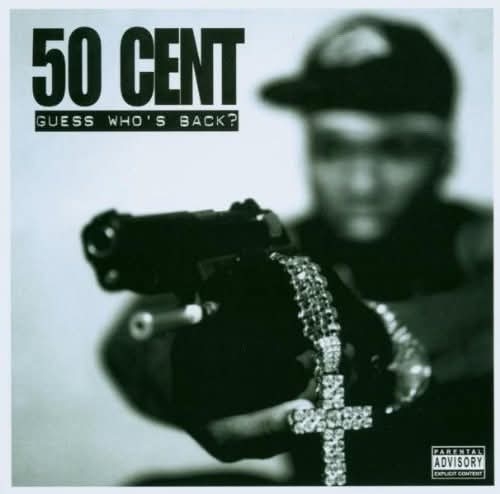
  • Released on May 21, 2002, Guess Who's Back? marked 50 Cent's defiant return to Hip-Hop after surviving a near-fatal shooting and being dropped by Columbia Records. The mixtape featured standout tracks like "Ghetto Qu'ran" and "Wanksta," produced by notable figures such as Trackmasters and DJ Clark Kent, showcasing his raw talent and street authenticity. Its raw portrayal of urban life not only caught Eminem's attention, leading to a deal with Shady Records, but also charted at number 28 on the Billboard 200, a rare feat for a mixtape, and inspired future generations of Hip-Hop artists, achieving platinum status nearly 20 years later.
    Released on May 21, 2002, Guess Who's Back? marked 50 Cent's defiant return to Hip-Hop after surviving a near-fatal shooting and being dropped by Columbia Records. The mixtape featured standout tracks like "Ghetto Qu'ran" and "Wanksta," produced by notable figures such as Trackmasters and DJ Clark Kent, showcasing his raw talent and street authenticity. Its raw portrayal of urban life not only caught Eminem's attention, leading to a deal with Shady Records, but also charted at number 28 on the Billboard 200, a rare feat for a mixtape, and inspired future generations of Hip-Hop artists, achieving platinum status nearly 20 years later.
    0 Kommentare 0 Anteile 2314 Ansichten
  • https://www.menshealth.com/fitness/a64702763/military-inspired-bodyweight-quad-workout/
    https://www.menshealth.com/fitness/a64702763/military-inspired-bodyweight-quad-workout/
    WWW.MENSHEALTH.COM
    The Military Muscle Workout That Will Transform Your Leg Day. No Weights Required.
    There are only two exercises, but you won't stop til you're done with every rep. Can your legs handle it?
    0 Kommentare 0 Anteile 479 Ansichten
  • 5 REASONS NOT TO QUIT:
    1. You’re closer than you think – (Gal. 6:9)
    2. Every storm eventually passes – (Ps. 30:5)
    3. God’s plan is still working – (Jer. 29:11)
    4. Strength grows in hard times – (Isa. 41:10)
    5. Your story will inspire others – (Rom. 8:28)
    5 REASONS NOT TO QUIT: 1. You’re closer than you think – (Gal. 6:9) 2. Every storm eventually passes – (Ps. 30:5) 3. God’s plan is still working – (Jer. 29:11) 4. Strength grows in hard times – (Isa. 41:10) 5. Your story will inspire others – (Rom. 8:28)
    0 Kommentare 0 Anteile 795 Ansichten
Suchergebnis