• Few people know that Brazil has the largest population of black people outside of the African continent. In fact, it is the second largest “Black nation” after Nigeria, with over 100 million Black people.

    Yet, there is little information in the media outside of the country about this group, specifically, information about the history of Africans in the country that defined and continues to define the affairs of black people globally. For example, the country’s Malê Revolt in its province of Bahia in 1835 is not only considered the most important revolt in Brazillian history but it is believed to have been instrumental in bringing an end to the international slave trade in the country.

    Historians say that on the night of January 24 to 25, 1835, African-born slaves and freed-people in the northeastern Brazilian city of Salvador da Bahia carried out a rebellion to liberate themselves from slavery and create an Islamic homeland. The group of some six hundred Yoruba, Nupe, Kanuri and Hausa people from present-day Nigeria were led by Muslim leaders, having heard of and being inspired by the Haitian Revolution (1791−1804).

    SOURCE: Face2FaceAfrica

    https://face2faceafrica.com/article/how-enslaved-nigerians-in-brazil-helped-usher-in-the-end-of-international-slave-trade-in-1835

    #Brazil #Nigeria #African #AfricanHistory #Yoruba #Hausa #Slavery #Haiti #HaitiRevolution
    Few people know that Brazil has the largest population of black people outside of the African continent. In fact, it is the second largest “Black nation” after Nigeria, with over 100 million Black people. Yet, there is little information in the media outside of the country about this group, specifically, information about the history of Africans in the country that defined and continues to define the affairs of black people globally. For example, the country’s Malê Revolt in its province of Bahia in 1835 is not only considered the most important revolt in Brazillian history but it is believed to have been instrumental in bringing an end to the international slave trade in the country. Historians say that on the night of January 24 to 25, 1835, African-born slaves and freed-people in the northeastern Brazilian city of Salvador da Bahia carried out a rebellion to liberate themselves from slavery and create an Islamic homeland. The group of some six hundred Yoruba, Nupe, Kanuri and Hausa people from present-day Nigeria were led by Muslim leaders, having heard of and being inspired by the Haitian Revolution (1791−1804). SOURCE: Face2FaceAfrica https://face2faceafrica.com/article/how-enslaved-nigerians-in-brazil-helped-usher-in-the-end-of-international-slave-trade-in-1835 #Brazil #Nigeria #African #AfricanHistory #Yoruba #Hausa #Slavery #Haiti #HaitiRevolution
    0 Commenti 0 condivisioni 545 Views
  • Did you know that Cuba had a policy to "Whiten" the African population? This is a very deep article that deals with 5 Countries that deliberately brought Europeans into their country to lighten the complexion of the people in many cases. Many of us don't know this aspect of history.

    "After the trans-Atlantic slave trade was officially abolished toward the end of the 19th century, many whites felt threatened and feared free Blacks would become a menacing element in society. The elites spent a great dealing of time mulling over how best to solve the so-called Negro problem. A popular solution that emerged during this period was the ideology of racial whitening or “whitening"."

    "Supporters of the “whitening” ideology believed that if a “superior” white population was encouraged to mix with an “inferior” Black population, Blacks would advance culturally, genetically or even disappear totally, within several generations. Some also believed that an influx of immigrants from Europe would be necessary to successfully carry out the process."

    Although both ideologies were driven by racism and white supremacy, whitening was in contrast to some countries that opted for segregation rather than miscegenation, ultimately outlawing the mixing of the races. This, however, was just a different means to the same end as these nations also imported more Europeans while slaughtering and oppressing the Black population.

    SOURCE:

    https://atlantablackstar.com/2014/03/10/5-black-nations-that-imported-europeans-to-whiten-the-population/

    #Africa #AfricanHistory #Cuba #Slavery #TheAHNShow #BlackHistoryMonth #BlackHistory
    Did you know that Cuba had a policy to "Whiten" the African population? This is a very deep article that deals with 5 Countries that deliberately brought Europeans into their country to lighten the complexion of the people in many cases. Many of us don't know this aspect of history. "After the trans-Atlantic slave trade was officially abolished toward the end of the 19th century, many whites felt threatened and feared free Blacks would become a menacing element in society. The elites spent a great dealing of time mulling over how best to solve the so-called Negro problem. A popular solution that emerged during this period was the ideology of racial whitening or “whitening"." "Supporters of the “whitening” ideology believed that if a “superior” white population was encouraged to mix with an “inferior” Black population, Blacks would advance culturally, genetically or even disappear totally, within several generations. Some also believed that an influx of immigrants from Europe would be necessary to successfully carry out the process." Although both ideologies were driven by racism and white supremacy, whitening was in contrast to some countries that opted for segregation rather than miscegenation, ultimately outlawing the mixing of the races. This, however, was just a different means to the same end as these nations also imported more Europeans while slaughtering and oppressing the Black population. SOURCE: https://atlantablackstar.com/2014/03/10/5-black-nations-that-imported-europeans-to-whiten-the-population/ #Africa #AfricanHistory #Cuba #Slavery #TheAHNShow #BlackHistoryMonth #BlackHistory
    0 Commenti 0 condivisioni 589 Views
  • This engraving depicts a scene from the Haitian Revolution (1791–1804), specifically titled "Revenge taken by the Black Army for the cruelties practiced on them by the French".

    The image portrays members of the Black Army—a force of formerly enslaved people and free people of color—executing French officers by hanging.

    The revolution was characterized by extreme violence on both sides.

    This particular scene was a direct response to the atrocities committed by French forces under General Charles Leclerc and General Rochambeau, who attempted to restore slavery and French control over the colony then known as Saint-Domingue.

    The artwork was created by Marcus Rainsford and published in 1805 in his book, An Historical Account of the Black Empire of Hayti.
    Rainsford, a former British captain, documented the revolution's events and provided some of the earliest visual records of the conflict.

    The image symbolizes the shift in power during the later stages of the revolution when the Black Army, led by figures like Jean-Jacques Dessalines, successfully repelled Napoleon Bonaparte's massive expeditionary force.

    The revolution began in August 1791 as a mass uprising of enslaved people inspired by the ideals of the French Revolution.

    It is widely regarded as the most successful slave rebellion in history, resulting in the permanent abolition of slavery and the establishment of Haiti as the world's first independent Black-led republic in 1804.
    This engraving depicts a scene from the Haitian Revolution (1791–1804), specifically titled "Revenge taken by the Black Army for the cruelties practiced on them by the French". The image portrays members of the Black Army—a force of formerly enslaved people and free people of color—executing French officers by hanging. The revolution was characterized by extreme violence on both sides. This particular scene was a direct response to the atrocities committed by French forces under General Charles Leclerc and General Rochambeau, who attempted to restore slavery and French control over the colony then known as Saint-Domingue. The artwork was created by Marcus Rainsford and published in 1805 in his book, An Historical Account of the Black Empire of Hayti. Rainsford, a former British captain, documented the revolution's events and provided some of the earliest visual records of the conflict. The image symbolizes the shift in power during the later stages of the revolution when the Black Army, led by figures like Jean-Jacques Dessalines, successfully repelled Napoleon Bonaparte's massive expeditionary force. The revolution began in August 1791 as a mass uprising of enslaved people inspired by the ideals of the French Revolution. It is widely regarded as the most successful slave rebellion in history, resulting in the permanent abolition of slavery and the establishment of Haiti as the world's first independent Black-led republic in 1804.
    0 Commenti 0 condivisioni 274 Views
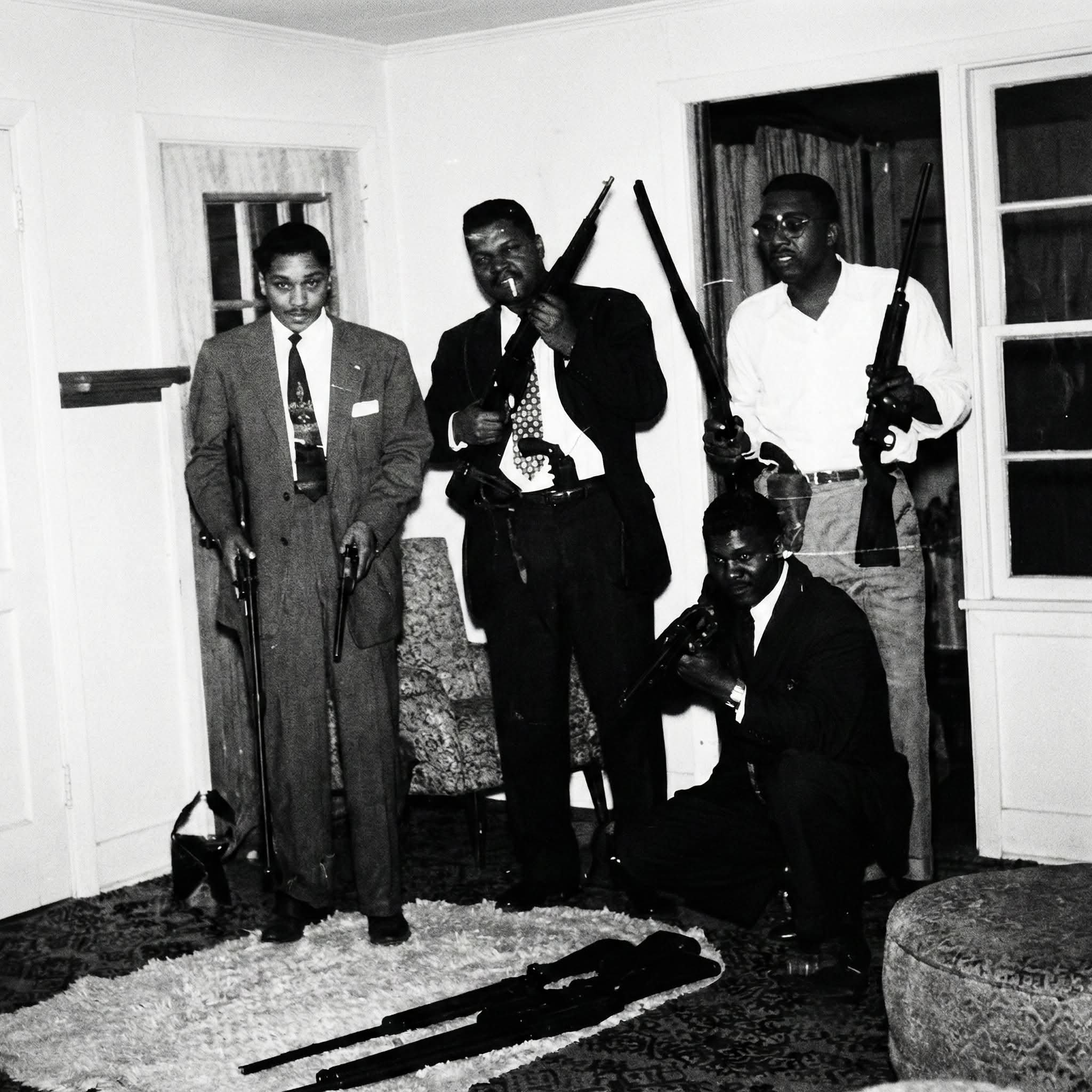
  • In the mid-1960s, there were towns in Louisiana where fear was not a rumor.
    It was a schedule.

    Night riders, threats, and intimidation were not distant headlines for Black families.
    They were the background noise of daily life in places where the Ku Klux Klan still worked openly.

    In Jonesboro, Louisiana, a group of Black men reached a point where prayer and patience alone could not be the only plan.
    They had families to get home to, and children who deserved to sleep without listening for trouble.

    So they made a decision that did not ask for permission.
    They organized.

    In 1964, they formed the Deacons for Defense and Justice.
    Their purpose was simple and serious: protect Black communities and civil rights workers when the state would not.

    A lot of the men who joined had already lived through combat.
    Many were veterans of World War II and the Korean War, men who understood both danger and discipline.

    That detail matters, because it tells you what kind of protection they believed in.
    They were not looking for chaos, and they were not pretending violence did not exist.

    The Deacons supported the civil rights movement, even as many public narratives focused only on strict nonviolence.
    They believed that defending Black life was not a contradiction, it was a responsibility.

    They did not form to attack anyone.
    They formed to prevent attacks, to stand guard, to escort people safely, and to make the Klan think twice.

    History often celebrates the front-facing moments, the speeches and marches that the cameras could capture.
    But some of the heaviest choices in the freedom struggle happened quietly, in rooms where men spoke in low voices about what it would take to keep everyone alive.

    You can imagine the kind of meetings they held.
    Not dramatic, not theatrical, just practical.

    Who needs an escort tonight.
    Which road is safest.

    Who is getting threatened for trying to register to vote.
    Who is sitting at home pretending they are not afraid.

    The Deacons existed because Black people were not asking for special treatment.
    They were asking for basic rights in a country that often refused to protect them while they did it.

    Their presence spread beyond Jonesboro as the need spread.
    Chapters and affiliated groups appeared in Louisiana and beyond, including a well-known chapter formed in Bogalusa in 1965, with growth into other Southern states.

    This is part of Black history that can make people uncomfortable, because it refuses the simplest version of the movement.
    It reminds us that courage came in more than one form, and that survival sometimes required more than a song.

    And still, the emotional truth stays steady.
    Black communities kept building life even under threat, and they did it with dignity that was never granted, only claimed.

    The Deacons for Defense and Justice also sit in an important place on the timeline.
    They formed years before the Black Panther Party was founded in Oakland in October 1966, and their example is often discussed as part of the wider story of Black self-defense in that era.

    That does not reduce the brilliance of any later movement.
    It expands the map and shows how many people were already thinking hard about protection, strategy, and community power.

    When we talk about Black resilience, we should not make it sound like Black people simply endured.
    Black people planned, organized, adapted, and defended what was precious.

    The Deacons were one chapter in that long tradition of looking after our own when institutions failed.
    They were proof that protecting the community can be an act of love as much as an act of resistance.

    This is why we have to keep teaching Black history, especially the stories that get skipped because they are complicated or unfamiliar.
    Our story is deeper than the version many of us were handed, and the deeper you go, the more you see how determined our people were to survive and to win.

    Looking back, the Deacons remind us that freedom work was not only public.
    It was also the quiet decision to stand watch so someone else could live one more day with hope.

    And looking forward, their story asks something gentle but firm of us.
    Learn it, tell it, and pass it on, so the next generation grows up knowing how wide, how brave, and how complete our history really is.

    #BlackHistory #Louisiana #CivilRightsHistory

    In the mid-1960s, there were towns in Louisiana where fear was not a rumor. It was a schedule. Night riders, threats, and intimidation were not distant headlines for Black families. They were the background noise of daily life in places where the Ku Klux Klan still worked openly. In Jonesboro, Louisiana, a group of Black men reached a point where prayer and patience alone could not be the only plan. They had families to get home to, and children who deserved to sleep without listening for trouble. So they made a decision that did not ask for permission. They organized. In 1964, they formed the Deacons for Defense and Justice. Their purpose was simple and serious: protect Black communities and civil rights workers when the state would not. A lot of the men who joined had already lived through combat. Many were veterans of World War II and the Korean War, men who understood both danger and discipline. That detail matters, because it tells you what kind of protection they believed in. They were not looking for chaos, and they were not pretending violence did not exist. The Deacons supported the civil rights movement, even as many public narratives focused only on strict nonviolence. They believed that defending Black life was not a contradiction, it was a responsibility. They did not form to attack anyone. They formed to prevent attacks, to stand guard, to escort people safely, and to make the Klan think twice. History often celebrates the front-facing moments, the speeches and marches that the cameras could capture. But some of the heaviest choices in the freedom struggle happened quietly, in rooms where men spoke in low voices about what it would take to keep everyone alive. You can imagine the kind of meetings they held. Not dramatic, not theatrical, just practical. Who needs an escort tonight. Which road is safest. Who is getting threatened for trying to register to vote. Who is sitting at home pretending they are not afraid. The Deacons existed because Black people were not asking for special treatment. They were asking for basic rights in a country that often refused to protect them while they did it. Their presence spread beyond Jonesboro as the need spread. Chapters and affiliated groups appeared in Louisiana and beyond, including a well-known chapter formed in Bogalusa in 1965, with growth into other Southern states. This is part of Black history that can make people uncomfortable, because it refuses the simplest version of the movement. It reminds us that courage came in more than one form, and that survival sometimes required more than a song. And still, the emotional truth stays steady. Black communities kept building life even under threat, and they did it with dignity that was never granted, only claimed. The Deacons for Defense and Justice also sit in an important place on the timeline. They formed years before the Black Panther Party was founded in Oakland in October 1966, and their example is often discussed as part of the wider story of Black self-defense in that era. That does not reduce the brilliance of any later movement. It expands the map and shows how many people were already thinking hard about protection, strategy, and community power. When we talk about Black resilience, we should not make it sound like Black people simply endured. Black people planned, organized, adapted, and defended what was precious. The Deacons were one chapter in that long tradition of looking after our own when institutions failed. They were proof that protecting the community can be an act of love as much as an act of resistance. This is why we have to keep teaching Black history, especially the stories that get skipped because they are complicated or unfamiliar. Our story is deeper than the version many of us were handed, and the deeper you go, the more you see how determined our people were to survive and to win. Looking back, the Deacons remind us that freedom work was not only public. It was also the quiet decision to stand watch so someone else could live one more day with hope. And looking forward, their story asks something gentle but firm of us. Learn it, tell it, and pass it on, so the next generation grows up knowing how wide, how brave, and how complete our history really is. #BlackHistory #Louisiana #CivilRightsHistory

    0 Commenti 0 condivisioni 377 Views
  • 0 Commenti 0 condivisioni 39 Views
  • 0 Commenti 0 condivisioni 44 Views
  • In the demanding world of industrial mining and heavy construction, tire protection chains serve as an indispensable steel armor for massive earthmovers. These intricately woven mesh systems wrap around the enormous rubber tires to shield them from the jagged, razor-sharp rocks typically found in quarries and underground mines. By acting as a sacrificial barrier, these chains prevent catastrophic punctures and surface tears that could lead to dangerous blowouts or costly operational downtime. Beyond mere protection, they significantly improve the machine's traction and stability on loose or slippery terrain, ensuring that these mechanical giants can operate with precision even in the most hostile environments.

    ​The primary driver behind adopting this technology is the staggering economic reality of heavy-duty equipment maintenance. A single tire for a large loader can command a price tag of tens of thousands of dollars, making any premature failure a significant financial blow to a project. By investing in high-quality steel chains, companies can effectively double or even triple the service life of their tires, transforming a vulnerable high-cost component into a durable long-term asset. This strategic layer of steel not only safeguards the equipment but also ensures a more sustainable and cost-effective workflow by minimizing the need for frequent, expensive replacements in the world’s toughest workspaces.
    In the demanding world of industrial mining and heavy construction, tire protection chains serve as an indispensable steel armor for massive earthmovers. These intricately woven mesh systems wrap around the enormous rubber tires to shield them from the jagged, razor-sharp rocks typically found in quarries and underground mines. By acting as a sacrificial barrier, these chains prevent catastrophic punctures and surface tears that could lead to dangerous blowouts or costly operational downtime. Beyond mere protection, they significantly improve the machine's traction and stability on loose or slippery terrain, ensuring that these mechanical giants can operate with precision even in the most hostile environments. ​The primary driver behind adopting this technology is the staggering economic reality of heavy-duty equipment maintenance. A single tire for a large loader can command a price tag of tens of thousands of dollars, making any premature failure a significant financial blow to a project. By investing in high-quality steel chains, companies can effectively double or even triple the service life of their tires, transforming a vulnerable high-cost component into a durable long-term asset. This strategic layer of steel not only safeguards the equipment but also ensures a more sustainable and cost-effective workflow by minimizing the need for frequent, expensive replacements in the world’s toughest workspaces.
    0 Commenti 0 condivisioni 235 Views
  • How plumbing vents actually work

    #Plumbing #PlumbingVents
    How plumbing vents actually work #Plumbing #PlumbingVents
    0 Commenti 0 condivisioni 59 Views
  • 0 Commenti 0 condivisioni 56 Views
  • 0 Commenti 0 condivisioni 48 Views